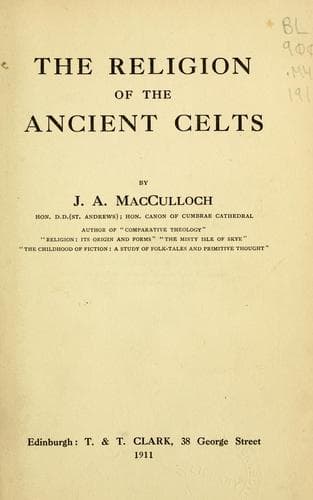
The Religion of the Ancient CeltsMacCulloch, J. A. (John Arnott)
Religion
The Religion of the Ancient Celts
MacCulloch, J. A. (John Arnott)
Celts -- Religion; Mythology, Celtic
folk survivals show that some such course as this had been pursued by
the Celts with regard to their divine kings, as it was also
elsewhere.[522] It is not impossible that some at least of the Druids
stood in a similar relation to the gods. Kings and priests were probably
at first not differentiated. In Galatia twelve "tetrarchs" met annually
with three hundred assistants at Drunemeton as the great national
council.[523] This council at a consecrated place (_nemeton_), its
likeness to the annual Druidic gathering in Gaul, and the possibility
that _Dru_- has some connection with the name "Druid," point to a
religious as well as political aspect of this council. The "tetrarchs"
may have been a kind of priest-kings; they had the kingly prerogative of
acting as judges as had the Druids of Gaul. The wife of one of them was
a priestess,[524] the office being hereditary in her family, and it may
have been necessary that her husband should also be a priest. One
tetrarch, Deiotarus, "divine bull," was skilled in augury, and the
priest-kingship of Pessinus was conferred on certain Celts in the second
century B.C., as if the double office were already a Celtic
institution.[525] Mythic Celtic kings consulted the gods without any
priestly intervention, and Queen Boudicca had priestly functions.[526]
Without giving these hints undue emphasis, we may suppose that the
differentiation of the two offices would not be simultaneous over the
Celtic area. But when it did take effect priests would probably lay
claim to the prerogatives of the priest-king as incarnate god. Kings
were not likely to give these up, and where they retained them priests
would be content with seeing that the tabus and ritual and the slaying
of the mock king were duly observed. Irish kings were perhaps still
regarded as gods, though certain Druids may have been divine priests,
since they called themselves creators of the universe, and both
continental and Irish Druids claimed superiority to kings. Further, the
name [Greek: semnotheoi], applied along with the name "Druids" to Celtic
priests, though its meaning is obscure, points to divine pretensions on
their part.[527]
Public-domain text, read in full here on John Shaqi.
Reviews
Reviews
No reviews yet
Be the first to share your thoughts on this work.
Elsewhere in the archive
Join the Discussion
Join the discussion
Sign in to leave a comment or review.
Sign InorCreate an account