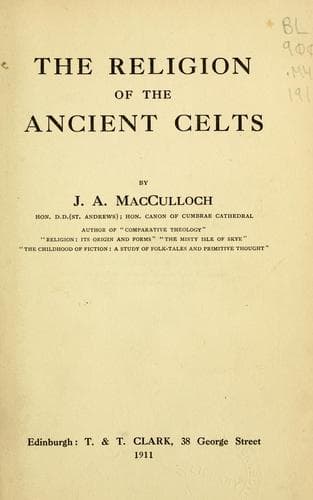
The Religion of the Ancient CeltsMacCulloch, J. A. (John Arnott)
Religion
The Religion of the Ancient Celts
MacCulloch, J. A. (John Arnott)
Celts -- Religion; Mythology, Celtic
The divinities often united with mortals. Goddesses sought the love of
heroes who were then sometimes numbered among the gods, and gods had
amours with the daughters of men.[518] Frequently the heroes of the
sagas are children of a god or goddess and a mortal,[519] and this
divine parentage was firmly believed in by the Celts, since personal
names formed of a divine name and _-genos_ or _-gnatos_, "born of," "son
of," are found in inscriptions over the whole Celtic area, or in Celtic
documents--Boduogenos, Camulognata, etc. Those who first bore these
names were believed to be of divine descent on one side. Spirits of
nature or the elements of nature personified might also be parents of
mortals, as a name like Morgen, from _Morigenos_, "Son of the Sea," and
many others suggest. For this and for other reasons the gods frequently
interfere in human affairs, assisting their children or their
favourites. Or, again, they seek the aid of mortals or of the heroes of
the sagas in their conflicts or in time of distress, as when Morrigan
besought healing from Cúchulainn.
As in the case of early Greek and Roman kings, Celtic kings who bore
divine names were probably believed to be representatives or
incarnations of gods. Perhaps this explains why a chief of the Boii
called himself a god and was revered after his death, and why the Gauls
so readily accepted the divinity of Augustus. Irish kings bear divine
names, and of these Nuada occurs frequently, one king, Irél Fáith, being
identified with Nuada Airgetlam, while in one text _nuadat_ is glossed
_in ríg_, "of the king," as if _Nuada_ had come to be a title meaning
"king." Welsh kings bear the name Nudd (Nodons), and both the actual and
the mythic leader Brennus took their name from the god Bran. King
Conchobar is called _día talmaide_, "a terrestrial god." If kings were
thought to be god-men like the Pharaohs, this might account for the
frequency of tales about divine fatherhood or reincarnation, while it
would also explain the numerous _geasa_ which Irish kings must observe,
unlike ordinary mortals. Prosperity was connected with their observance,
though this prosperity was later thought to depend on the king's
goodness. The nature of the prosperity--mild seasons, abundant crops,
fruit, fish, and cattle--shows that the king was associated with
fertility, like the gods of growth.[520] Hence they had probably been
once regarded as incarnations of such gods. Wherever divine kings are
found, fertility is bound up with them and with the due observance of
their tabus. To prevent misfortune to the land, they are slain before
they grow old and weak, and their vigour passes on to their successors.
Their death benefits their people.[521] But frequently the king might
reign as long as he could hold his own against all comers, or, again, a
slave or criminal was for a time treated as a mock king, and slain as
the divine king's substitute. Scattered hints in Irish literature and in
Public-domain text, read in full here on John Shaqi.
Reviews
Reviews
No reviews yet
Be the first to share your thoughts on this work.
Elsewhere in the archive
Join the Discussion
Join the discussion
Sign in to leave a comment or review.
Sign InorCreate an account