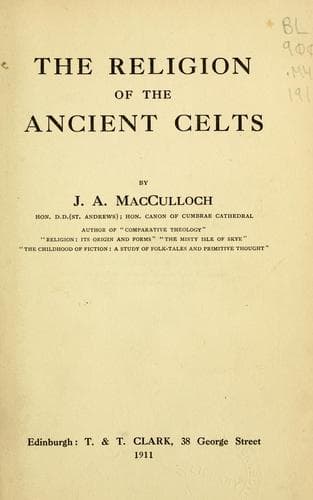
The Religion of the Ancient CeltsMacCulloch, J. A. (John Arnott)
Religion
The Religion of the Ancient Celts
MacCulloch, J. A. (John Arnott)
Celts -- Religion; Mythology, Celtic
"Cold fountain! Surface of strand ...
Sea of lake, water of Gara, stream of river;
High spring well; cold fountain!"[560]
The goddess Morrigan, after the defeat of the Fomorians, invokes the
powers of nature and proclaims the victory to "the royal mountains of
Ireland, to its chief waters, and its river mouths."[561] It was also
customary to take oaths by the elements--heaven, earth, sun, fire, moon,
sea, land, day, night, etc., and these punished the breaker of the
oath.[562] Even the gods exacted such an oath of each other. Bres swore
by sun, moon, sea, and land, to fulfil the engagement imposed on him by
Lug.[563] The formulæ survived into Christian times, and the faithful
were forbidden to call the sun and moon gods or to swear by them, while
in Breton folk-custom at the present day oaths by sun, moon, or earth,
followed by punishment of the oath-breaker by the moon, are still in
use.[564] These oaths had originated in a time when the elements
themselves were thought to be divine, and similar adjurations were used
by Greeks and Scandinavians.
While the greater objects of nature were worshipped for themselves
alone, the Celts also peopled the earth with spirits, benevolent or
malevolent, of rocks, hills, dales, forests, lakes, and streams,[565]
and while greater divinities of growth had been evolved, they still
believed in lesser spirits of vegetation, of the corn, and of fertility,
connected, however, with these gods. Some of these still survive as
fairies seen in meadows, woodlands, or streams, or as demoniac beings
haunting lonely places. And even now, in French folk-belief, sun, moon,
winds, etc., are regarded as actual personages. Sun and moon are husband
and wife; the winds have wives; they are addressed by personal names and
reverenced.[566] Some spirits may already have had a demoniac aspect in
pagan times. The Tuatha Déa conjured up _meisi_, "spectral bodies that
rise from the ground," against the Milesians, and at their service were
malignant sprites--_urtrochta_, and "forms, spectres, and great queens"
called _guidemain_ (false demons). The Druids also sent forth
mischievous spirits called _siabra_. In the _Táin_ there are references
to _bocânachs_, _banânaichs_, and _geniti-glinni_, "goblins, eldritch
beings, and glen-folk."[567] These are twice called Tuatha Dé Danann,
and this suggests that they were nature-spirits akin to the greater
gods.[568] The _geniti-glinni_ would be spirits haunting glen and
valley. They are friendly to Cúchulainn in the _Táin_, but in the _Feast
of Bricriu_ he and other heroes fight and destroy them.[569] In modern
Irish belief they are demons of the air, perhaps fallen angels.[570]
Public-domain text, read in full here on John Shaqi.
Reviews
Reviews
No reviews yet
Be the first to share your thoughts on this work.
Elsewhere in the archive
Join the Discussion
Join the discussion
Sign in to leave a comment or review.
Sign InorCreate an account