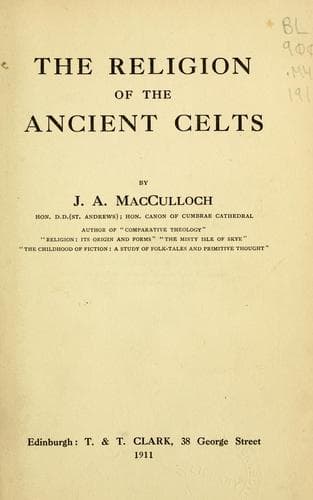
The Religion of the Ancient CeltsMacCulloch, J. A. (John Arnott)
Religion
The Religion of the Ancient Celts
MacCulloch, J. A. (John Arnott)
Celts -- Religion; Mythology, Celtic
Much of this is probably pre-Celtic as well as Celtic, but it held its
ground because it was dear to the Celts themselves. They upheld the
aboriginal cults resembling those which, in the lands whence they came,
had been native and local with themselves. Such cults are as old as the
world, and when Christianity expelled the worship of the greater gods,
younger in growth, the ancient nature worship, dowered with immortal
youth,
"bowed low before the blast
In patient deep disdain,"
to rise again in vigour. Preachers, councils, and laws inveighed against
it. The old rites continued to be practised, or survived under a
Christian dress and colouring. They are found in Breton villages, in
Highland glens, in Welsh and Cornish valleys, in Irish townships, and
only the spread of school-board education, with its materialism and
uninviting common sense, is forcing them at last to yield.
The denunciations of these cults throw some light upon them. Offerings
at trees, stones, fountains, and cross-roads, the lighting of fires or
candles there, and vows or incantations addressed to them, are
forbidden, as is also the worship of trees, groves, stones, rivers, and
wells. The sun and moon are not to be called lords. Wizardry, and
divination, and the leapings and dancings, songs and choruses of the
pagans, i.e. their orgiastic cults, are not to be practised.
Tempest-raisers are not to ply their diabolical craft.[571] These
denunciations, of course, were not without their effect, and legend told
how the spirits of nature were heard bewailing the power of the
Christian saints, their mournful cries echoing in wooded hollows,
secluded valleys, and shores of lake and river.[572] Their power, though
limited, was not annihilated, but the secrecy in which the old cults
often continued to be practised gave them a darker colour. They were
identified with the works of the devil, and the spirits of paganism with
dark and grisly demons.[573] This culminated in the mediæval witch
persecutions, for witchcraft was in part the old paganism in a new
guise. Yet even that did not annihilate superstition, which still lives
and flourishes among the folk, though the actual worship of
nature-spirits has now disappeared.
* * * * *
Public-domain text, read in full here on John Shaqi.
Reviews
Reviews
No reviews yet
Be the first to share your thoughts on this work.
Elsewhere in the archive
Join the Discussion
Join the discussion
Sign in to leave a comment or review.
Sign InorCreate an account