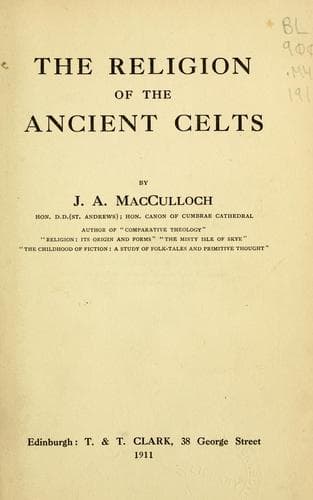
The Religion of the Ancient CeltsMacCulloch, J. A. (John Arnott)
Religion
The Religion of the Ancient Celts
MacCulloch, J. A. (John Arnott)
Celts -- Religion; Mythology, Celtic
Sanctuaries were erected at these springs by grateful worshippers, and
at some of them festivals were held, or they were the resort of
pilgrims. As sources of fertility they had a place in the ritual of the
great festivals, and sacred wells were visited on Midsummer day, when
also the river-gods claimed their human victims. Some of the goddesses
were represented by statues or busts in Gallo-Roman times, if not
earlier, and other images of them which have been found were of the
nature of _ex votos_, presented by worshippers in gratitude for the
goddess's healing gifts. Money, ingots of gold or silver, and models of
limbs or other parts of the body which had been or were desired to be
healed, were also presented. Gregory of Tours says of the Gauls that
they "represent in wood or bronze the members in which they suffer, and
whose healing they desire, and place them in a temple."[610] Contact of
the model with the divinity brought healing to the actual limbs on the
principle of sympathetic magic. Many such models have been discovered.
Thus in the shrine of Dea Sequana was found a vase with over a hundred;
another contained over eight hundred. Inscriptions were engraved on
plaques which were fastened to the walls of temples, or placed in
springs.[611] Leaden tablets with inscriptions were placed in springs by
those who desired healing or when the waters were low, and on some the
actual waters are hardly discriminated from the divinities. The latter
are asked to heal or flow or swell--words which apply more to the waters
than to them, while the tablets, with their frank animism, also show
that, in some cases, there were many elemental spirits of a well, only
some of whom were rising to the rank of a goddess. They are called
collectively _Niskas_--the Nixies of later tradition, but some have
personal names--Lerano, Dibona, Dea--showing that they were tending to
become separate divine personalities. The Peisgi are also appealed to,
perhaps the later Piskies, unless the word is a corrupt form of a Celtic
_peiskos_, or the Latin _piscus_, "fish."[612] This is unlikely, as fish
could not exist in a warm sulphurous spring, though the Celts believed
in the sacred fish of wells or streams. The fairies now associated with
wells or with a water-world beneath them, are usually nameless, and only
in a few cases have a definite name. They, like the older spirits of the
wells, have generally a beneficent character.[613] Thus in the fountains
of Logres dwelt damsels who fed the wayfarer with meat and bread, until
grievous wrong was done them, when they disappeared and the land became
waste.[614] Occasionally, however, they have a more malevolent
character.[615]
Public-domain text, read in full here on John Shaqi.
Reviews
Reviews
No reviews yet
Be the first to share your thoughts on this work.
Elsewhere in the archive
Join the Discussion
Join the discussion
Sign in to leave a comment or review.
Sign InorCreate an account