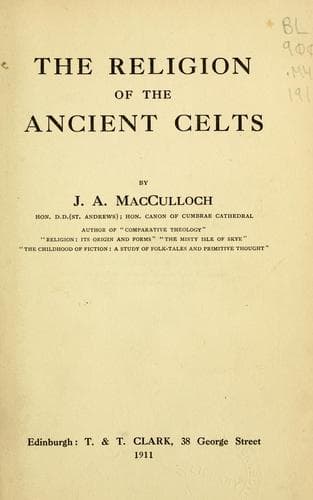
The Religion of the Ancient CeltsMacCulloch, J. A. (John Arnott)
Religion
The Religion of the Ancient Celts
MacCulloch, J. A. (John Arnott)
Celts -- Religion; Mythology, Celtic
The spirit of the waters was often embodied in an animal, usually a
fish. Even now in Brittany the fairy dweller in a spring has the form of
an eel, while in the seventeenth century Highland wells contained fish
so sacred that no one dared to catch them.[616] In Wales S. Cybi's well
contained a huge eel in whose virtues the villagers believed, and terror
prevailed when any one dared to take it from the water. Two sacred fish
still exist in a holy well at Nant Peris, and are replaced by others
when they die, the dead fish being buried.[617] This latter act,
solemnly performed, is a true sign of the divine or sacred character of
the animal. Many wells with sacred fish exist in Ireland, and the fish
have usually some supernatural quality--they never alter in size, they
become invisible, or they take the form of beautiful women.[618] Any one
destroying such fish was regarded as a sacrilegious person, and
sometimes a hostile tribe killed and ate the sacred fish of a district
invaded by them, just as Egyptians of one nome insulted those of another
by killing their sacred animals.[619] In old Irish beliefs the salmon
was the fish of knowledge. Thus whoever ate the salmon of Connla's well
was dowered with the wisdom which had come to them through eating nuts
from the hazels of knowledge around the well. In this case the sacred
fish was eaten, but probably by certain persons only--those who had the
right to do so. Sinend, who went to seek inspiration from the well,
probably by eating one of its salmon, was overwhelmed by its waters. The
legend of the salmon is perhaps based on old ritual practices of the
occasional eating of a divine animal. In other cases, legends of a
miraculous supply of fish from sacred wells are perhaps later Christian
traditions of former pagan beliefs or customs concerning magical methods
of increasing a sacred or totem animal species, like those used in
Central Australia and New Guinea.[620] The frog is sometimes the sacred
animal, and this recalls the _Märchen_ of the Frog Bridegroom living in
a well, who insisted on marrying the girl who drew its waters. Though
this tale is not peculiar to the Celts, it is not improbable that the
divine animal guardian of a well may have become the hero of a
folk-tale, especially as such wells were sometimes tabu to women.[621] A
fly was the guardian spirit of S. Michael's well in Banffshire. Auguries
regarding health were drawn from its movements, and it was believed that
the fly, when it grew old, transmigrated into another.[622]
Such beliefs were not peculiarly Celtic. They are found in all European
folk-lore, and they are still alive among savages--the animal being
itself divine or the personification of a divinity. A huge sacred eel
was worshipped by the Fijians; in North America and elsewhere there were
serpent guardians of the waters; and the Semites worshipped the fish of
sacred wells as incarnations or symbols of a god.
Public-domain text, read in full here on John Shaqi.
Reviews
Reviews
No reviews yet
Be the first to share your thoughts on this work.
Elsewhere in the archive
Join the Discussion
Join the discussion
Sign in to leave a comment or review.
Sign InorCreate an account