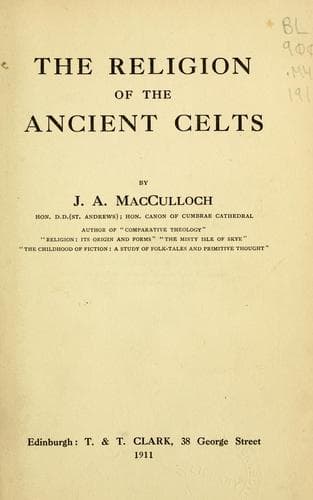
The Religion of the Ancient CeltsMacCulloch, J. A. (John Arnott)
Religion
The Religion of the Ancient Celts
MacCulloch, J. A. (John Arnott)
Celts -- Religion; Mythology, Celtic
Later Celtic folk-belief associated monstrous and malevolent beings with
rivers and lakes. These may be the older divinities to whom a demoniac
form has been given, but even in pagan times such monstrous beings may
have been believed in, or they may be survivals of the more primitive
monstrous guardians of the waters. The last were dragons or serpents,
conventional forms of the reptiles which once dwelt in watery places,
attacking all who came near. This old idea certainly survived in Irish
and Highland belief, for the Fians conquered huge dragons or serpents in
lochs, or saints chained them to the bottom of the waters. Hence the
common place-name of Loch na piast, "Loch of the Monster." In other
tales they emerge and devour the impious or feast on the dead.[623] The
_Dracs_ of French superstition--river monsters who assume human form and
drag down victims to the depths, where they devour them--resemble these.
The _Each Uisge_, or "Water-horse," a horse with staring eyes, webbed
feet, and a slimy coat, is still dreaded. He assumes different forms and
lures the unwary to destruction, or he makes love in human shape to
women, some of whom discover his true nature by seeing a piece of
water-weed in his hair, and only escape with difficulty. Such a
water-horse was forced to drag the chariot of S. Fechin of Fore, and
under his influence became "gentler than any other horse."[624] Many
Highland lochs are still haunted by this dreaded being, and he is also
known in Ireland and France, where, however, he has more of a tricky and
less of a demoniac nature.[625] His horse form is perhaps connected with
the similar form ascribed to Celtic water-divinities. Manannan's horses
were the waves, and he was invariably associated with a horse. Epona,
the horse-goddess, was perhaps originally goddess of a spring, and, like
the _Matres_, she is sometimes connected with the waters.[626] Horses
were also sacrificed to river-divinities.[627] But the beneficent
water-divinities in their horse form have undergone a curious
distortion, perhaps as the result of later Christian influences. The
name of one branch of the Fomorians, the Goborchinn, means the
"Horse-headed," and one of their kings was Eochaid Echchenn, or
"Horse-head."[628] Whether these have any connection with the
water-horse is uncertain.
The foaming waters may have suggested another animal personification,
since the name of the Boyne in Ptolemy, [Greek: bououinda], is derived
from a primitive _bóu-s_, "ox," and _vindo-s_, "white," in Irish _bó
find_, "white cow."[629] But it is not certain that this or the Celtic
cult of the bull was connected with the belief in the _Tarbh Uisge_, or
"Water-bull," which had no ears and could assume other shapes. It dwells
in lochs and is generally friendly to man, occasionally emerging to mate
with ordinary cows. In the Isle of Man the _Tarroo Ushtey_, however,
begets monsters.[630] These Celtic water-monsters have a curious
resemblance to the Australian _Bunyip_.
Public-domain text, read in full here on John Shaqi.
Reviews
Reviews
No reviews yet
Be the first to share your thoughts on this work.
Elsewhere in the archive
Join the Discussion
Join the discussion
Sign in to leave a comment or review.
Sign InorCreate an account