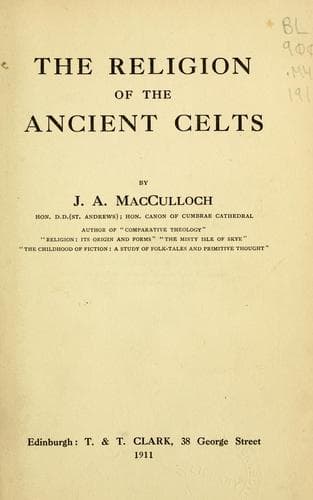
The Religion of the Ancient CeltsMacCulloch, J. A. (John Arnott)
Religion
The Religion of the Ancient Celts
MacCulloch, J. A. (John Arnott)
Celts -- Religion; Mythology, Celtic
Certain waters had the power of ejecting the demon of madness. Besides
drinking, the patient was thrown into the waters, the shock being
intended to drive the demon away, as elsewhere demons are exorcised by
flagellation or beating. The divinity of the waters aided the process,
and an offering was usually made to him. In other cases the sacred
waters were supposed to ward off disease from the district or from those
who drank of them. Or, again, they had the power of conferring
fertility. Women made pilgrimages to wells, drank or bathed in the
waters, implored the spirit or saint to grant them offspring, and made a
due offering.[652] Spirit or saint, by a transfer of his power, produced
fruitfulness, but the idea was in harmony with the recognised power of
water to purify, strengthen, and heal. Women, for a similar reason,
drank or washed in the waters or wore some articles dipped in them, in
order to have an easy delivery or abundance of milk.[653]
The waters also gave oracles, their method of flowing, the amount of
water in the well, the appearance or non-appearance of bubbles at the
surface when an offering was thrown in, the sinking or floating of
various articles, all indicating whether a cure was likely to occur,
whether fortune or misfortune awaited the inquirer, or, in the case of
girls, whether their lovers would be faithful. The movements of the
animal guardian of the well were also ominous to the visitor.[654]
Rivers or river divinities were also appealed to. In cases of suspected
fidelity the Celts dwelling by the Rhine placed the newly-born child in
a shield on the waters. If it floated the mother was innocent; if it
sank it was allowed to drown, and she was put to death.[655] Girls whose
purity was suspected were similarly tested, and S. Gregory of Tours
tells how a woman accused of adultery was proved by being thrown into
the Saône.[656] The mediæval witch ordeal by water is connected with
this custom, which is, however, widespread.[657]
Public-domain text, read in full here on John Shaqi.
Reviews
Reviews
No reviews yet
Be the first to share your thoughts on this work.
Elsewhere in the archive
Join the Discussion
Join the discussion
Sign in to leave a comment or review.
Sign InorCreate an account