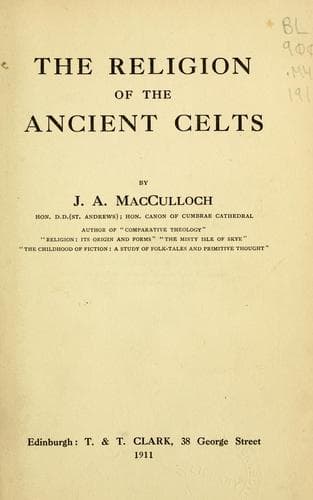
The Religion of the Ancient CeltsMacCulloch, J. A. (John Arnott)
Religion
The Religion of the Ancient Celts
MacCulloch, J. A. (John Arnott)
Celts -- Religion; Mythology, Celtic
The malevolent aspect of the spirit of the well is seen in the "cursing
wells" of which it was thought that when some article inscribed with an
enemy's name was thrown into them with the accompaniment of a curse, the
spirit of the well would cause his death. In some cases the curse was
inscribed on a leaden tablet thrown into the waters, just as, in other
cases, a prayer for the offerer's benefit was engraved on it. Or, again,
objects over which a charm had been said were placed in a well that the
victim who drew water might be injured. An excellent instance of a
cursing-well is that of Fynnon Elian in Denbigh, which must once have
had a guardian priestess, for in 1815 an old woman who had charge of it
presided at the ceremony. She wrote the name of the victim in a book,
receiving a gift at the same time. A pin was dropped into the well in
the name of the victim, and through it and through knowledge of his
name, the spirit of the well acted upon him to his hurt.[658] Obviously
rites like these, in which magic and religion mingle, are not purely
Celtic, but it is of interest to note their existence in Celtic lands
and among Celtic folk.
FOOTNOTES:
[597] _Ethnol. in Folklore_, 104 f.
[598] D'Arbois, _PH_ ii. 132, 169; Dottin, 240.
[599] Justin, xxxii. 3; Strabo, iv. 1. 13.
[600] S. Gregory, _In Glor. Conf._ ch. 2. Perhaps the feast and
offerings were intended to cause rain in time of drought. See p. 321,
_infra_.
[601] Adamman, _Vita Colum._ ii. 10.
[602] See Holder, _s.v._
[603] D'Arbois, _RC_ x. 168, xiv. 377; _CIL_ xii. 33; Propertius, iv.
10. 41.
[604] See p. 349, _infra_.
[605] Cf. Ptolemy's [Greek: Dêouana] and [Greek: Dêouna] (ii. 3. 19, 11.
29); the Scots and English Dee; the Divy in Wales; Dêve, Dive, and
Divette in France; Devon in England; Deva in Spain (Ptolemy's [Greek:
Dêoua], ii. 6. 8). The Shannon is surnamed even in the seventh century
"the goddess" (_Trip. Life_, 313).
[606] Holder, _s.v._; D'Arbois, _PH_ ii. 119, thinks _Matrona_ is
Ligurian. But it seems to have strong Celtic affinities.
[607] Rh[^y]s, _HL_ 27-29, _RC_ iv. 137.
[608] On the whole subject see Pictet, "Quelques noms celtiques de
rivières," _RC_ ii. 1 f. Orosius, v. 15. 6, describes the sacrifices of
gold, silver, and horses, made to the Rhône.
[609] Maury, 18. By extension of this belief any divinity might appear
by the haunted spring. S. Patrick and his synod of bishops at an Irish
well were supposed to be _síd_ or gods (p. 64, _supra_.) By a fairy well
Jeanne d'Arc had her first vision.
[610] Greg. Tours, _Vita Patr._ c. 6.
[611] See Reinach, _Catal. Sommaire_, 23, 115; Baudot, _Rapport sur les
fouilles faits aux sources de la Seine_, ii. 120; _RC_ ii. 26.
[612] For these tablets see Nicolson, _Keltic Studies_, 131 f.; Jullian,
_RC_ 1898.
[613] Sébillot, ii. 195.
[614] Prologue to Chrestien's _Conte du Graal_.
[615] Sébillot, ii. 202 f.
[616] Ibid. 196-197; Martin, 140-141; Dalyell, 411.
Public-domain text, read in full here on John Shaqi.
Reviews
Reviews
No reviews yet
Be the first to share your thoughts on this work.
Elsewhere in the archive
Join the Discussion
Join the discussion
Sign in to leave a comment or review.
Sign InorCreate an account