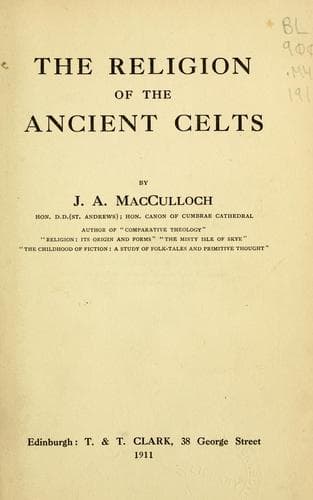
The Religion of the Ancient CeltsMacCulloch, J. A. (John Arnott)
Religion
The Religion of the Ancient Celts
MacCulloch, J. A. (John Arnott)
Celts -- Religion; Mythology, Celtic
[638] _Rendes Dindsenchas_, _RC_ xv. 315, 457. Other instances of
punishment following misuse of a well are given in Sébillot, ii. 192;
Rees, 520, 523. An Irish lake no longer healed after a hunter swam his
mangy hounds through it (Joyce, _PN_ ii. 90). A similar legend occurs
with the Votiaks, one of whose sacred lakes was removed to its present
position because a woman washed dirty clothes in it (_L'Anthropologie_,
xv. 107).
[639] Rh[^y]s, _CFL_ i. 392.
[640] Girald. Cambr. _Itin. Hib._ ii. 9; Joyce, _OCR_ 97; Kennedy, 281;
O'Grady, i. 233; Skene, ii. 59; Campbell, _WHT_ ii. 147. The waters
often submerge a town, now seen below the waves--the town of Is in
Armorica (Le Braz, i. p. xxxix), or the towers under Lough Neagh. In
some Welsh instances a man is the culprit (Rh[^y]s, _CFL_ i. 379). In
the case of Lough Neagh the keeper of the well was Liban, who lived on
in the waters as a mermaid. Later she was caught and received the
baptismal name of Muirghenn, "sea-birth." Here the myth of a
water-goddess, said to have been baptized, is attached to the legend of
the careless guardian of a spring, with whom she is identified (O'Grady,
ii. 184, 265).
[641] Roberts, _Cambrian Pop. Antiq._ 246; Hunt, _Popular Romances_,
291; _New Stat. Account_, x. 313.
[642] Thorpe, _Northern Myth._ ii. 78.
[643] Joyce, _PN_ ii. 84. _Slán_ occurs in many names of wells.
Well-worship is denounced in the canons of the Fourth Council of Arles.
[644] Cartailhac, _L'Age de Pierre_, 74; Bulliot et Thiollier, _Mission
de S. Martin_, 60.
[645] Sébillot, ii. 284.
[646] Dalyell, 79-80; Sébillot, ii. 282, 374; see p. 266, _infra_.
[647] I have compiled this account of the ritual from notices of the
modern usages in various works. See, e.g., Moore, _Folk-Lore_, v. 212;
Mackinley, _passim_; Hope, _Holy Wells_; Rh[^y]s, _CFL_; Sébillot, 175
f.; Dixon, _Gairloch_, 150 f.
[648] Brand, ii. 68; Greg. _In Glor. Conf._ c. 2.
[649] Sébillot, ii. 293, 296; _Folk-Lore_, iv. 55.
[650] Mackinley, 194; Sébillot, ii. 296.
[651] _Folk-Lore_, iii. 67; _Athenæum_, 1893, 415; Pliny, _Ep._ viii. 8;
Strabo, iv. 287; Diod. Sic. v. 9.
[652] Walker, _Proc. Soc. Ant. Scot._ vol. v.; Sébillot, ii. 232. In
some early Irish instances a worm swallowed with the waters by a woman
causes pregnancy. See p. 352, _infra_.
[653] Sébillot, ii. 235-236.
[654] See Le Braz, i. 61; _Folk-Lore_, v. 214; Rh[^y]s, _CFL_ i. 364;
Dalyell, 506-507; Scott, _Minstrelsy_, Introd. xliii; Martin, 7;
Sébillot, ii. 242 f.; _RC_ ii. 486.
[655] Jullian, _Ep. to Maximin_, 16. The practice may have been
connected with that noted by Aristotle, of plunging the newly-born into
a river, to strengthen it, as he says (_Pol._ vii. 15. 2), but more
probably as a baptismal or purificatory rite. See p. 309, _infra_.
[656] Lefevre, _Les Gaulois_, 109; Michelet, _Origines du droit
français_, 268.
[657] See examples of its use in Post, _Grundriss der Ethnol.
Jurisprudenz_, ii. 459 f.
Public-domain text, read in full here on John Shaqi.
Reviews
Reviews
No reviews yet
Be the first to share your thoughts on this work.
Elsewhere in the archive
Join the Discussion
Join the discussion
Sign in to leave a comment or review.
Sign InorCreate an account