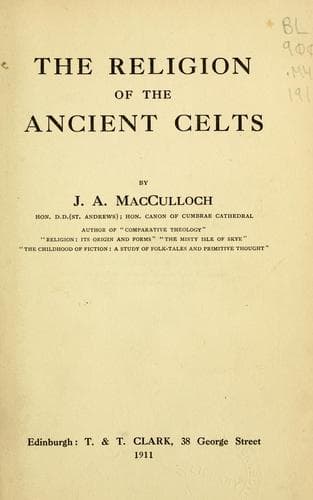
The Religion of the Ancient CeltsMacCulloch, J. A. (John Arnott)
Religion
The Religion of the Ancient Celts
MacCulloch, J. A. (John Arnott)
Celts -- Religion; Mythology, Celtic
[658] Roberts, _Cambrian Popular Antiquities_, 246.
CHAPTER XIII.
TREE AND PLANT WORSHIP.
The Celts had their own cult of trees, but they adopted local
cults--Ligurian, Iberian, and others. The _Fagus Deus_ (the divine
beech), the _Sex arbor_ or _Sex arbores_ of Pyrenean inscriptions, and
an anonymous god represented by a conifer on an altar at Toulouse,
probably point to local Ligurian tree cults continued by the Celts into
Roman times.[659] Forests were also personified or ruled by a single
goddess, like _Dea Arduinna_ of the Ardennes and _Dea Abnoba_ of the
Black Forest.[660] But more primitive ideas prevailed, like that which
assigned a whole class of tree-divinities to a forest, e.g. the _Fatæ
Dervones_, spirits of the oak-woods of Northern Italy.[661] Groups of
trees like _Sex arbores_ were venerated, perhaps for their height,
isolation, or some other peculiarity.
The Celts made their sacred places in dark groves, the trees being hung
with offerings or with the heads of victims. Human sacrifices were hung
or impaled on trees, e.g. by the warriors of Boudicca.[662] These, like
the offerings still placed by the folk on sacred trees, were attached to
them because the trees were the abode of spirits or divinities who in
many cases had power over vegetation.
Pliny said of the Celts: "They esteem nothing more sacred than the
mistletoe and the tree on which it grows. But apart from this they
choose oak-woods for their sacred groves, and perform no sacred rite
without using oak branches."[663] Maximus of Tyre also speaks of the
Celtic (? German) image of Zeus as a lofty oak, and an old Irish
glossary gives _daur_, "oak," as an early Irish name for "god," and
glosses it by _dia_, "god."[664] The sacred need-fire may have been
obtained by friction from oak-wood, and it is because of the old
sacredness of the oak that a piece of its wood is still used as a
talisman in Brittany.[665] Other Aryan folk besides the Celts regarded
the oak as the symbol of a high god, of the sun or the sky,[666] but
probably this was not its earliest significance. Oak forests were once
more extensive over Europe than they are now, and the old tradition that
men once lived on acorns has been shown to be well-founded by the
witness of archæological finds, e.g. in Northern Italy.[667] A people
living in an oak region and subsisting in part on acorns might easily
take the oak as a representative of the spirit of vegetation or growth.
It was long-lived, its foliage was a protection, it supplied food, its
wood was used as fuel, and it was thus clearly the friend of man. For
these reasons, and because it was the most abiding and living thing men
knew, it became the embodiment of the spirits of life and growth.
Folk-lore survivals show that the spirit of vegetation in the shape of
his representative was annually slain while yet in full vigour, that his
life might benefit all things and be passed on undiminished to his
Public-domain text, read in full here on John Shaqi.
Reviews
Reviews
No reviews yet
Be the first to share your thoughts on this work.
Elsewhere in the archive
Join the Discussion
Join the discussion
Sign in to leave a comment or review.
Sign InorCreate an account