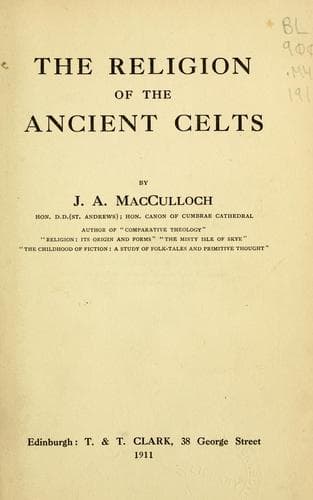
The Religion of the Ancient CeltsMacCulloch, J. A. (John Arnott)
Religion
The Religion of the Ancient Celts
MacCulloch, J. A. (John Arnott)
Celts -- Religion; Mythology, Celtic
successor.[668] Hence the oak or a human being representing the spirit
of vegetation, or both together, were burned in the Midsummer fires.
How, then, did the oak come to symbolise a god equated with Zeus. Though
the equation may be worthless, it is possible that the connection lay in
the fact that Zeus and Juppiter had agricultural functions, or that,
when the equation was made, the earlier spirit of vegetation had become
a divinity with functions resembling those of Zeus. The fires were
kindled to recruit the sun's life; they were fed with oak-wood, and in
them an oak or a human victim representing the spirit embodied in the
oak was burned. Hence it may have been thought that the sun was
strengthened by the fire residing in the sacred oak; it was thus "the
original storehouse or reservoir of the fire which was from time to time
drawn out to feed the sun."[669] The oak thus became the symbol of a
bright god also connected with growth. But, to judge by folk survivals,
the older conception still remained potent, and tree or human victim
affected for good all vegetable growth as well as man's life, while at
the same time the fire strengthened the sun.
Dr. Evans argues that "the original holy object within the central
triliths of Stonehenge was a sacred tree," an oak, image of the Celtic
Zeus. The tree and the stones, once associated with ancestor worship,
had become symbols of "a more celestial Spirit or Spirits than those of
departed human beings."[670] But Stonehenge has now been proved to have
been in existence before the arrival of the Celts, hence such a cult
must have been pre-Celtic, though it may quite well have been adopted by
the Celts. Whether this hypothetical cult was practised by a tribe, a
group of tribes, or by the whole people, must remain obscure, and,
indeed, it may well be questioned whether Stonehenge was ever more than
the scene of some ancestral rites.
Other trees--the yew, the cypress, the alder, and the ash, were
venerated, to judge by what Lucan relates of the sacred grove at
Marseilles. The Irish Druids attributed special virtues to the hazel,
rowan, and yew, the wood of which was used in magical ceremonies
described in Irish texts.[671] Fires of rowan were lit by the Druids of
rival armies, and incantations said over them in order to discomfit the
opposing host,[672] and the wood of all these trees is still believed to
be efficacious against fairies and witches.
Public-domain text, read in full here on John Shaqi.
Reviews
Reviews
No reviews yet
Be the first to share your thoughts on this work.
Elsewhere in the archive
Join the Discussion
Join the discussion
Sign in to leave a comment or review.
Sign InorCreate an account