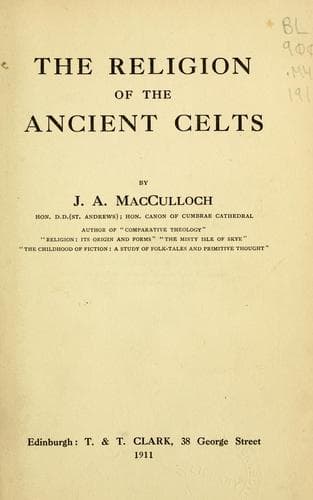
The Religion of the Ancient CeltsMacCulloch, J. A. (John Arnott)
Religion
The Religion of the Ancient Celts
MacCulloch, J. A. (John Arnott)
Celts -- Religion; Mythology, Celtic
We now turn to Pliny's account of the mistletoe rite. The Druids held
nothing more sacred than this plant and the tree on which it grew,
probably an oak. Of it groves were formed, while branches of the oak
were used in all religious rites. Everything growing on the oak had been
sent from heaven, and the presence of the mistletoe showed that God had
selected the tree for especial favour. Rare as it was, when found the
mistletoe was the object of a careful ritual. On the sixth day of the
moon it was culled. Preparations for a sacrifice and feast were made
beneath the tree, and two white bulls whose horns had never been bound
were brought there. A Druid, clad in white, ascended the tree and cut
the mistletoe with a golden sickle. As it fell it was caught in a white
cloth; the bulls were then sacrificed, and prayer was made that God
would make His gift prosperous to those on whom He had bestowed it. The
mistletoe was called "the universal healer," and a potion made from it
caused barren animals to be fruitful. It was also a remedy against all
poisons.[687] We can hardly believe that such an elaborate ritual merely
led up to the medico-magical use of the mistletoe. Possibly, of course,
the rite was an attenuated survival of something which had once been
more important, but it is more likely that Pliny gives only a few
picturesque details and passes by the _rationale_ of the ritual. He does
not tell us who the "God" of whom he speaks was, perhaps the sun-god or
the god of vegetation. As to the "gift," it was probably in his mind the
mistletoe, but it may quite well have meant the gift of growth in field
and fold. The tree was perhaps cut down and burned; the oxen may have
been incarnations of a god of vegetation, as the tree also may have
been. We need not here repeat the meaning which has been given to the
ritual,[688] but it may be added that if this meaning is correct, the
rite probably took place at the time of the Midsummer festival, a
festival of growth and fertility. Mistletoe is still gathered on
Midsummer eve and used as an antidote to poisons or for the cure of
wounds. Its Druidic name is still preserved in Celtic speech in words
signifying "all-healer," while it is also called _sùgh an daraich_, "sap
of the oak," and _Druidh lus_, "Druid's weed."[689]
Public-domain text, read in full here on John Shaqi.
Reviews
Reviews
No reviews yet
Be the first to share your thoughts on this work.
Elsewhere in the archive
Join the Discussion
Join the discussion
Sign in to leave a comment or review.
Sign InorCreate an account