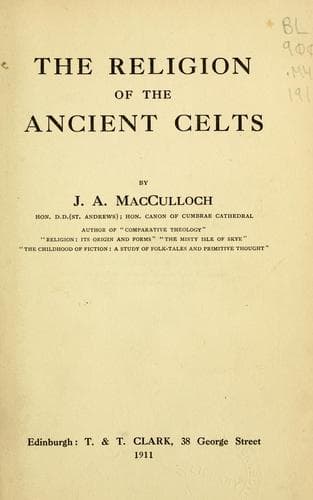
The Religion of the Ancient CeltsMacCulloch, J. A. (John Arnott)
Religion
The Religion of the Ancient Celts
MacCulloch, J. A. (John Arnott)
Celts -- Religion; Mythology, Celtic
Pliny describes other Celtic herbs of grace. _Selago_ was culled without
use of iron after a sacrifice of bread and wine--probably to the spirit
of the plant. The person gathering it wore a white robe, and went with
unshod feet after washing them. According to the Druids, _Selago_
preserved one from accident, and its smoke when burned healed maladies
of the eye.[690] _Samolus_ was placed in drinking troughs as a remedy
against disease in cattle. It was culled by a person fasting, with the
left hand; it must be wholly uprooted, and the gatherer must not look
behind him.[691] _Vervain_ was gathered at sunrise after a sacrifice to
the earth as an expiation--perhaps because its surface was about to be
disturbed. When it was rubbed on the body all wishes were gratified; it
dispelled fevers and other maladies; it was an antidote against
serpents; and it conciliated hearts. A branch of the dried herb used to
asperge a banquet-hall made the guests more convivial[692]
The ritual used in gathering these plants--silence, various tabus,
ritual purity, sacrifice--is found wherever plants are culled whose
virtue lies in this that they are possessed by a spirit. Other plants
are still used as charms by modern Celtic peasants, and, in some cases,
the ritual of gathering them resembles that described by Pliny.[693] In
Irish sagas plants have magical powers. "Fairy herbs" placed in a bath
restored beauty to women bathing therein.[694] During the _Táin_
Cúchulainn's wounds were healed with "balsams and healing herbs of fairy
potency," and Diancecht used similar herbs to restore the dead at the
battle of Mag-tured.[695]
FOOTNOTES:
[659] Sacaze, _Inscr. des Pyren._ 255; Hirschfeld, _Sitzungsberichte_
(Berlin, 1896), 448.
[660] _CIL_ vi. 46; _CIR_ 1654, 1683.
[661] D'Arbois, _Les Celtes_, 52.
[662] Lucan, _Phar._ Usener's ed., 32; Orosius, v. 16. 6; Dio Cass.
lxii. 6.
[663] Pliny, xvi. 44. The Scholiast on Lucan says that the Druids
divined with acorns (Usener, 33).
[664] Max. Tyr. _Diss._ viii. 8; Stokes, _RC_ i. 259.
[665] Le Braz, ii. 18.
[666] Mr. Chadwick (_Jour. Anth. Inst._ xxx. 26) connects this high god
with thunder, and regards the Celtic Zeus (Taranis, in his opinion) as a
thunder-god. The oak was associated with this god because his
worshippers dwelt under oaks.
[667] Helbig, _Die Italiker in der Poebene_, 16 f.
[668] Mannhardt, _Baumkultus_; Frazer, _Golden Bough_{2} iii. 198.
[669] Frazer, _loc. cit._
[670] Evans, _Arch. Rev._ i. 327 f.
[671] Joyce, _SH_ i. 236.
[672] O'Curry, _MC_ i. 213.
[673] _LL_ 199_b_; _Rennes Dindsenchas_, _RC_ xv. 420.
[674] _RC_ xv. 455, xvi. 279; Hennessey, _Chron. Scot._ 76.
[675] Keating, 556; Joyce, _PN_ i. 499.
[676] Wood-Martin, ii. 159.
[677] D'Arbois, _Les Celtes_, 51; Jullian, 41.
[678] Cook, _Folk-Lore_, xvii. 60.
[679] See Sébillot, i. 293; Le Braz, i. 259; _Folk-Lore Journal_, v.
218; _Folk-Lore Record_, 1882.
[680] Val. Probus, _Comm. in Georgica_, ii. 84.
Public-domain text, read in full here on John Shaqi.
Reviews
Reviews
No reviews yet
Be the first to share your thoughts on this work.
Elsewhere in the archive
Join the Discussion
Join the discussion
Sign in to leave a comment or review.
Sign InorCreate an account