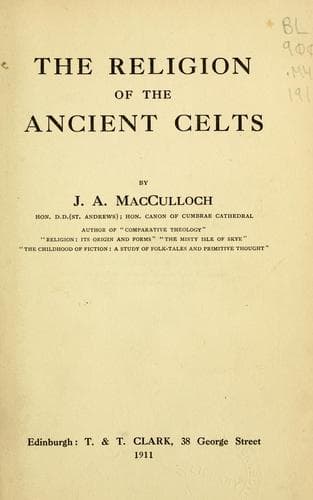
The Religion of the Ancient CeltsMacCulloch, J. A. (John Arnott)
Religion
The Religion of the Ancient Celts
MacCulloch, J. A. (John Arnott)
Celts -- Religion; Mythology, Celtic
for this as well as the breaking of other tabus, he lost his life.[749]
It was tabu to Cúchulainn, "the hound of Culann," to eat dog's flesh,
and, having been persuaded to do this, his strength went from him, and
he perished. Diarmaid, having been forbidden to hunt a boar with which
his life was connected, was induced by Fionn to break this tabu, and in
consequence he lost his life by one of the boar's bristles entering his
foot, or (in a variant) by the boar's killing him. Another instance is
found in a tale of certain men transformed to badgers. They were slain
by Cormac, and brought to his father Tadg to eat. Tadg unaccountably
loathed them, because they were transformed men and his cousins.[750] In
this tale, which may contain the _débris_ of totemic usage, the loathing
arises from the fact that the badgers are men--a common form of myths
explanatory of misunderstood totemic customs, but the old idea of the
relation between a man and his totem is not lost sight of. The other
tales may also be reminiscent of a clan totem tabu, later centred in a
mythic hero. Perhaps the belief in lucky or unlucky animals, or in omens
drawn from their appearance, may be based on old totem beliefs or in
beliefs in the divinity of the animals.
(3) _Sacramental eating of an animal._--The custom of "hunting the
wren," found over the whole Celtic area, is connected with animal
worship and may be totemistic in origin. In spite of its small size, the
wren was known as the king of birds, and in the Isle of Man it was
hunted and killed on Christmas or S. Stephen's day. The bird was carried
in procession from door to door, to the accompaniment of a chant, and
was then solemnly buried, dirges being sung. In some cases a feather was
left at each house and carefully treasured, and there are traces of a
custom of boiling and eating the bird.[751] In Ireland, the hunt and
procession were followed by a feast, the materials of which were
collected from house to house, and a similar usage obtained in France,
where the youth who killed the bird was called "king."[752] In most of
these districts it was considered unlucky or dangerous to kill the bird
at any other time, yet it might be ceremonially killed once a year, the
dead animal conferred luck, and was solemnly eaten or buried with signs
of mourning. Similar customs with animals which are actually worshipped
are found elsewhere,[753] and they lend support to the idea that the
Celts regarded the wren as a divine animal, or perhaps a totem animal,
that it was necessary to slay it ritually, and to carry it round the
houses of the community to obtain its divine influence, to eat it
sacramentally or to bury it. Probably like customs were followed in the
case of other animals,[754] and these may have given rise to such
stories as that of the eating of MacDatho's wonderful boar, as well as
to myths which regarded certain animals, e.g. the swine, as the immortal
food of the gods.
Public-domain text, read in full here on John Shaqi.
Reviews
Reviews
No reviews yet
Be the first to share your thoughts on this work.
Elsewhere in the archive
Join the Discussion
Join the discussion
Sign in to leave a comment or review.
Sign InorCreate an account