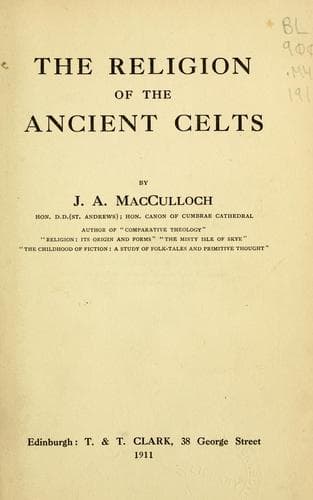
The Religion of the Ancient CeltsMacCulloch, J. A. (John Arnott)
Religion
The Religion of the Ancient Celts
MacCulloch, J. A. (John Arnott)
Celts -- Religion; Mythology, Celtic
Other examples of ritual survivals of such sacramental
eating have already been noted, and it is not improbable that the eating
of a sacred pastoral animal occurred at Samhain.
(4) _Exogamy._--Exogamy and the counting of descent through the mother
are closely connected with totemism, and some traces of both are found
among the Celts. Among the Picts, who were, perhaps, a Celtic group of
the Brythonic stock, these customs survived in the royal house. The
kingship passed to a brother of the king by the same mother, or to a
sister's son, while the king's father was never king and was frequently
a "foreigner." Similar rules of succession prevailed in early Aryan
royal houses--Greek and Roman,--and may, as Dr. Stokes thought, have
existed at Tara in Ireland, while in a Fian tale of Oisin he marries the
daughter of the king of Tír na n-Og, and succeeds him as king partly for
that reason, and partly because he had beaten him in the annual race for
the kingship.[755] Such an athletic contest for the kingship was known
in early Greece, and this tale may support the theory of the Celtic
priest-kingship, the holder of the office retaining it as long as he was
not defeated or slain. Traces of succession through a sister's son are
found in the _Mabinogion_, and Livy describes how the mythic Celtic king
Ambicatus sent not his own but his sister's sons to found new
kingdoms.[756] Irish and Welsh divine and heroic groups are named after
the mother, not the father--the children of Danu and of Dôn, and the men
of Domnu. Anu is mother of the gods, Buanann of heroes. The eponymous
ancestor of the Scots is a woman, Scota, and the earliest colonisers of
Ireland are women, not men. In the sagas gods and heroes have frequently
a matronymic, and the father's name is omitted--Lug mac Ethnend,
Conchobar mac Nessa, Indech, son of De Domnann, Corpre, son of Etain,
and others. Perhaps parallel to this is the custom of calling men after
their wives--e.g. the son of Fergus is Fer Tlachtga, Tlachtga's
husband.[757] In the sagas, females (goddesses and heroines) have a high
place accorded to them, and frequently choose their own lovers or
husbands--customs suggestive of the matriarchate. Thus what was once a
general practice was later confined to the royal house or told of divine
or heroic personages. Possibly certain cases of incest may really be
exaggerated accounts of misunderstood unions once permissible by totemic
law. Cæsar speaks of British polyandry, brothers, sons, and fathers
sharing a wife in common.[758] Strabo speaks of Irish unions with
mothers and sisters, perhaps referring not to actual practice but to
reports of saga tales of incest.[759] Dio Cassius speaks of community of
wives among the Caledonians and Meatæ, and Jerome says much the same of
the Scoti and Atecotti.[760] These notices, with the exception of
Cæsar's, are vague, yet they refer to marriage customs different from
those known to their reporters. In Irish sagas incest legends circle
Public-domain text, read in full here on John Shaqi.
Reviews
Reviews
No reviews yet
Be the first to share your thoughts on this work.
Elsewhere in the archive
Join the Discussion
Join the discussion
Sign in to leave a comment or review.
Sign InorCreate an account