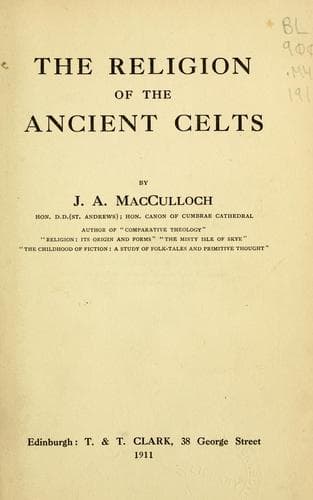
The Religion of the Ancient CeltsMacCulloch, J. A. (John Arnott)
Religion
The Religion of the Ancient Celts
MacCulloch, J. A. (John Arnott)
Celts -- Religion; Mythology, Celtic
[700] Leahy, ii. 105 f.; Curtin, _MFI_ 264, 318; Joyce, _PN_ i. 174;
Rees, 453. Cf. Ailred, _Life of S. Ninian_, c. 8.
[701] Jocelyn, _Vita S. Kentig._ c. 24; Rees, 293, 323.
[702] Tacitus, _Germ._ xlv.; Blanchet, i. 162, 165; Reinach, _BF_ 255
f., _CMR_ i. 168; Bertrand, _Arch. Celt._ 419.
[703] Pennant, _Tour in Scotland_, 268; Reinach, _RC_ xxii. 158, _CMR_
i. 67.
[704] Pausan, vii. 17, 18; Johnson, _Journey_, 136.
[705] Joyce, _SH_ ii. 127; _IT_ i. 99, 256 (Bricriu's feast and the tale
of Macdatho's swine).
[706] Strabo, iv. 4. 3, says these swine attacked strangers. Varro, _de
Re Rustica_, ii. 4, admires their vast size. Cf. Polyb. ii. 4.
[707] The hunt is first mentioned in Nennius, c. 79, and then appears as
a full-blown folk-tale in _Kulhwych_, Loth, i. 185 f. Here the boar is a
transformed prince.
[708] I have already suggested, p. 106, _supra_, that the places where
Gwydion halted with the swine of Elysium were sites of a swine-cult.
[709] _RC_ xiii. 451. Cf. also _TOS_ vi. "The Enchanted Pigs of Oengus,"
and Campbell, _LF_ 53.
[710] _L'Anthropologie_, vi. 584; Greenwell, _British Barrows_, 274,
283, 454; _Arch. Rev._ ii. 120.
[711] _Rev. Arch._ 1897, 313.
[712] Reinach, "Zagreus le serpent cornu," _Rev. Arch_. xxxv. 210.
[713] Reinach, _BF_ 185; Bertrand, 316.
[714] "Cúchulainn's Sick-bed," D'Arbois, v. 202.
[715] See Reinach, _CMR_ i. 57.
[716] _CIL_ xiii. 5160, xii. 2199. Rh[^y]s, however, derives Artaios
from _ar_, "ploughed land," and equates the god with Mercurius Cultor.
[717] _CIL_ xii. 1556-1558; D'Arbois, _RC_ x. 165.
[718] For all these place and personal names, see Holder and D'Arbois,
_op. cit. Les Celtes_, 47 f., _Les Druides_, 157 f.
[719] See p. 32, _supra_; Reinach, _CMR_ i. 72, _Rev. Arch._ ii. 123.
[720] O'Grady, ii. 123.
[721] Epona is fully discussed by Reinach in his _Epona_, 1895, and in
articles (illustrated) in _Rev. Arch._ vols. 26, 33, 35, 40, etc. See
also ii. [1898], 190.
[722] Reinach suggests that this may explain why Vercingetorix, in view
of siege by the Romans, sent away his horses. They were too sacred to be
eaten. Cæsar, vii. 71; Reinach, _RC_ xxvii. 1 f.
[723] Juvenal, viii. 154; Apul. _Metam._ iii. 27; Min. Felix, _Octav._
xxvii. 7.
[724] For the inscriptions, see Holder, _s.v._ "Epona."
[725] _CIL_ iii. 7904.
[726] _CIL_ xiii. 3071; Reinach, _BF_ 253, _CMR_ i. 64, _Répert. de la
Stat._ ii. 745; Holder, ii. 651-652.
[727] Granger, _Worship of the Romans_, 113; Kennedy, 135.
[728] Grimm, _Teut. Myth._ 49, 619, 657, 661-664.
[729] Frazer, _Golden Bough_{2}, ii. 281, 315.
[730] Cæsar, v. 21, 27. Possibly the Dea Bibracte of the Aeduans was a
beaver goddess.
[731] O'Curry, _MC_ ii. 207; Elton, 298.
[732] Girald. Cambr. _Top. Hib._ ii. 19, _RC_ ii. 202; _Folk-Lore_, v.
310; _IT_ iii. 376.
[733] O'Grady, ii. 286, 538; Campbell, _The Fians_, 78; Thiers, _Traité
des Superstitions_, ii. 86.
[734] Lady Guest, ii. 409 f.
[735] Blanchet, i. 166, 295, 326, 390.
Public-domain text, read in full here on John Shaqi.
Reviews
Reviews
No reviews yet
Be the first to share your thoughts on this work.
Elsewhere in the archive
Join the Discussion
Join the discussion
Sign in to leave a comment or review.
Sign InorCreate an account