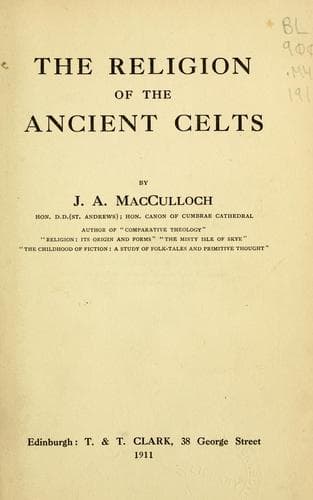
The Religion of the Ancient CeltsMacCulloch, J. A. (John Arnott)
Religion
The Religion of the Ancient Celts
MacCulloch, J. A. (John Arnott)
Celts -- Religion; Mythology, Celtic
Celtic animal worship dates back to the primitive hunting and pastoral
period, when men worshipped the animals which they hunted or reared.
They may have apologised to the animal hunted and slain--a form of
worship, or, where animals were not hunted or were reared and
worshipped, one of them may have been slain annually and eaten to obtain
its divine power. Care was taken to preserve certain sacred animals
which were not hunted, and this led to domestication, the abstinence of
earlier generations leading to an increased food supply at a later time,
when domesticated animals were freely slain. But the earlier sacramental
slaying of such animals survived in the religious aspect of their
slaughter at the beginning of winter.[764] The cult of animals was also
connected with totemic usage, though at a later stage this cult was
replaced by that of anthropomorphic divinities, with the older divine
animals as their symbols, sacrificial victims, and the like. This
evolution now led to the removal of restrictions upon slaying and eating
the animals. On the other hand, the more primitive animal cults may have
remained here and there. Animal cults were, perhaps, largely confined to
men. With the rise of agriculture mainly as an art in the hands of
women, and the consequent cult of the Earth-mother, of fertility and
corn-spirits probably regarded as female, the sacramental eating of the
divine animal may have led to the slaying and eating of a human or
animal victim supposed to embody such a spirit. Later the two cults were
bound to coalesce, and the divine animal and the animal embodiment of
the vegetation spirit would not be differentiated. On the other hand,
when men began to take part in women's fertility cults, the fact that
such spirits were female or were perhaps coming to be regarded as
goddesses, may have led men to envisage certain of the anthropomorphic
animal divinities as goddesses, since some of these, e.g. Epona and
Damona, are female. But with the increasing participation of men in
agriculture, the spirits or goddesses of fertility would tend to become
male, or the consorts or mothers of gods of fertility, though the
earlier aspect was never lost sight of, witness the Corn-Mother. The
evolution of divine priest-kings would cause them to take the place of
the earlier priestesses of these cults, one of whom may have been the
divine victim. Yet in local survivals certain cults were still confined
to women, and still had their priestesses.[765]
FOOTNOTES:
[696] Reinach, _BF_ 66, 244. The bull and three cranes may be a rebus on
the name of the bull, _Tarvos Trikarenos_, "the three-headed," or
perhaps _Trikeras_, "three-horned."
[697] Plutarch, _Marius_, 23; Cæsar, vii. 65; D'Arbois, _Les Celtes_,
49.
[698] Holder, _s.v._ _Tarba_, _Tarouanna_, _Tarvisium_, etc.; D'Arbois,
_Les Druides_, 155; S. Greg. _In Glor. Conf._ 48.
[699] _CIL_ xiii. 6017; _RC_ xxv. 47; Holder, ii. 528.
Public-domain text, read in full here on John Shaqi.
Reviews
Reviews
No reviews yet
Be the first to share your thoughts on this work.
Elsewhere in the archive
Join the Discussion
Join the discussion
Sign in to leave a comment or review.
Sign InorCreate an account