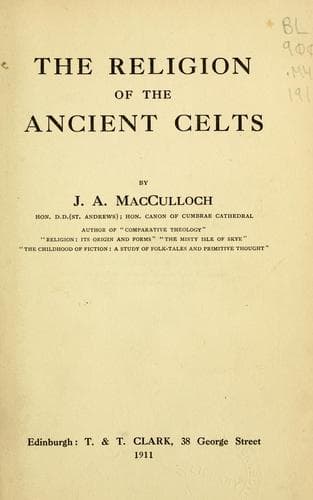
The Religion of the Ancient CeltsMacCulloch, J. A. (John Arnott)
Religion
The Religion of the Ancient Celts
MacCulloch, J. A. (John Arnott)
Celts -- Religion; Mythology, Celtic
Those gods who were connected with the sky may have been held to dwell
there or on the mountain supporting it. Others, like the Celtic
Dispater, dwelt underground. Some were connected with mounds and hills,
or were supposed to have taken up their abode in them. Others, again,
dwelt in a distant region, the Celtic Elysium, which, once the Celts
reached the sea, became a far-off island. Those divinities worshipped in
groves were believed to dwell there and to manifest themselves at midday
or midnight, while such objects of nature as rivers, wells, and trees
were held to be the abode of gods or spirits. Thus it is doubtful
whether the Celts ever thought of their gods as dwelling in one Olympus.
The Tuatha Dé Danann are said to have come from heaven, but this may be
the mere assertion of some scribe who knew not what to make of this
group of beings.
In Celtic belief men were not so much created by gods as descended from
them. "All the Gauls assert that they are descended from Dispater, and
this, they say, has been handed down to them by the Druids."[770]
Dispater was a Celtic underworld god of fertility, and the statement
probably presupposes a myth, like that found among many primitive
peoples, telling how men once lived underground and thence came to the
surface of the earth. But it also points to their descent from the god
of the underworld. Thither the dead returned to him who was ancestor of
the living as well as lord of the dead.[771] On the other hand, if the
earth had originally been thought of as a female, she as Earth-mother
would be ancestress of men. But her place in the myth would easily be
taken by the Earth or Under-earth god, perhaps regarded as her son or
her consort. In other cases, clans, families, or individuals often
traced their descent to gods or divine animals or plants. Classical
writers occasionally speak of the origin of branches of the Celtic race
from eponymous founders, perhaps from their knowledge of existing Celtic
myths.[772] Ammianus Marcellinus also reports a Druidic tradition to the
effect that some Gauls were indigenous, some had come from distant
islands, and others from beyond the Rhine.[773] But this is not so much
a myth of origins, as an explanation of the presence of different
peoples in Gaul--the aborigines, the Celtæ, and the Belgic Gauls. M.
D'Arbois assumes that "distant islands" means the Celtic Elysium, which
he regards as the land of the dead,[774] but the phrase is probably no
more than a distorted reminiscence of the far-off lands whence early
groups of Celts had reached Gaul.
Public-domain text, read in full here on John Shaqi.
Reviews
Reviews
No reviews yet
Be the first to share your thoughts on this work.
Elsewhere in the archive
Join the Discussion
Join the discussion
Sign in to leave a comment or review.
Sign InorCreate an account