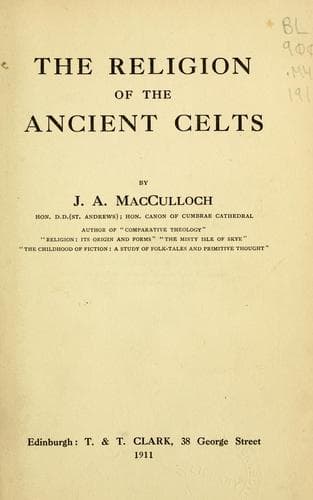
The Religion of the Ancient CeltsMacCulloch, J. A. (John Arnott)
Religion
The Religion of the Ancient Celts
MacCulloch, J. A. (John Arnott)
Celts -- Religion; Mythology, Celtic
Of the creation of the world no complete myth has survived, though from
a gloss to the _Senchus Mór_ we learn that the Druids, like the
Br[=a]hmans, boasted that they had made sun, moon, earth, and sea--a
boast in keeping with their supposed powers over the elements.[775]
Certain folk-beliefs, regarding the origin of different parts of nature,
bear a close resemblance to primitive cosmogonic myths, and they may be
taken as _disjecta membra_ of similar myths held by the Celts and
perhaps taught by the Druids. Thus sea, rivers, or springs arose from
the micturition of a giant, fairy, or saint, or from their sweat or
blood. Islands are rocks cast by giants, and mountains are the material
thrown up by them as they were working on the earth. Wells sprang up
from the blood of a martyr or from the touch of a saint's or a fairy's
staff.[776] The sea originated from a magic cask given by God to a
woman. The spigot, when opened, could not be closed again, and the cask
never ceased running until the waters covered the earth--a tale with
savage parallels.[777] In all these cases, giant, saint, or fairy has
doubtless taken the place of a god, since the stories have a very
primitive _facies_. The giant is frequently Gargantua, probably himself
once a divinity. Other references in Irish texts point to the common
cosmogonic myth of the earth having gradually assumed its present form.
Thus many new lakes and plains are said to have been formed in Ireland
during the time of Partholan and Nemed, the plains being apparently
built up out of existing materials.[778] In some cases the formation of
a lake was the result of digging the grave of some personage after whom
the lake was then named.[779] Here we come upon the familiar idea of the
danger of encroaching on the domain of a deity, e.g. that of the
Earth-god, by digging the earth, with the consequent punishment by a
flood. The same conception is found in Celtic stories of a lake or river
formed from the overflowing of a sacred well through human carelessness
or curiosity, which led to the anger of the divinity of the well.[780]
Or, again, a town or castle is submerged on account of the wickedness of
its inhabitants, the waters being produced by the curse of God or a
saint (replacing a pagan god) and forming a lake.[781] These may be
regarded as forms of a Celtic deluge-myth, which in one case, that of
the Welsh story of the ship of Nevyd, which saved Dwyvan and Dwyfach and
a pair of all kinds of animals when Lake Llion overflowed, has
apparently borrowed from the Biblical story.[782] In other cases lakes
are formed from the tears of a god, e.g. Manannan, whose tears at the
death of his son formed three lochs in Erin.[783] Apollonius reports
that the waters of Eridanus originated from the tears of Apollo when
driven from heaven by his father.[784] This story, which he says is
Celtic, has been clothed by him in a Greek form, and the god in question
may have been Belenos, equated with Apollo.
Public-domain text, read in full here on John Shaqi.
Reviews
Reviews
No reviews yet
Be the first to share your thoughts on this work.
Elsewhere in the archive
Join the Discussion
Join the discussion
Sign in to leave a comment or review.
Sign InorCreate an account