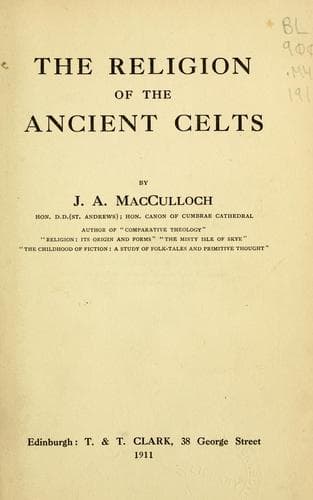
The Religion of the Ancient CeltsMacCulloch, J. A. (John Arnott)
Religion
The Religion of the Ancient Celts
MacCulloch, J. A. (John Arnott)
Celts -- Religion; Mythology, Celtic
Sometimes the formation of
streams was ascribed to great hail-storms--an evident mythic rendering
of the damage done by actual spates, while the Irish myths of
"illimitable sea-bursts," of which three particular instances are often
mentioned, were doubtless the result of the experience of tidal waves.
Although no complete account of the end of all things, like that of the
Scandinavian Ragnarok, has survived, scattered hints tell of its former
existence. Strabo says that the Druids taught that "fire and water must
one day prevail"--an evident belief in some final cataclysm.[785] This
is also hinted at in the words of certain Gauls to Alexander, telling
him that what they feared most of all was the fall of the heavens upon
their heads.[786] In other words, they feared what would be the signal
of the end of all things. On Irish ground the words of Conchobar may
refer to this. He announced that he would rescue the captives and spoil
taken by Medb, unless the heavens fell, and the earth burst open, and
the sea engulphed all things.[787] Such a myth mingled with Christian
beliefs may underlie the prophecy of Badb after Mag-tured regarding the
evils to come and the end of the world, and that of Fercertne in the
_Colloquy of the Two Sages_.[788] Both have a curious resemblance to the
Sybil's prophecy of doom in the Voluspa. If the gods themselves were
involved in such a catastrophe, it would not be surprising, since in
some aspects their immortality depended on their eating and drinking
immortal food and drink.[789]
FOOTNOTES:
[766] Avienus, _Ora Maritima_, 644 f.
[767] _IT_ i. 25; Gaidoz, _ZCP_ i. 27.
[768] _Annales de Bretagne_, x. 414.
[769] _IT_ i. 50, cf. 184; _Folk-Lore_, vi. 170.
[770] Cæsar, vi. 18.
[771] See p. 341, _infra_.
[772] Diod. Sic. v. 24; Appian, _Illyrica_, 2.
[773] Amm. Marcel, xv. 9.
[774] D'Arbois, ii. 262, xii. 220.
[775] _Antient Laws of Ireland_, i. 23. In one MS. Adam is said to have
been created thus--his body of earth, his blood of the sea, his face of
the sun, his breath of the wind, etc. This is also found in a Frisian
tale (Vigfusson-Powell, _Corpus Poet. Bor._ i. 479), and both stories
present an inversion of well-known myths about the creation of the
universe from the members of a giant.
[776] Sébillot, i. 213 f., ii. 6, 7, 72, 97, 176, 327-328. Cf. _RC_ xv.
482, xvi. 152.
[777] Sébillot, ii. 6.
[778] _LL_ 56; Keating, 117, 123.
[779] _RC_ xv. 429, xvi. 277.
[780] See p. 191, _supra_.
[781] Sébillot, ii. 41 f., 391, 397; see p. 372, _infra_.
[782] _Triads_ in Loth, ii. 280, 299; Rh[^y]s, _HL_ 583, 663.
[783] _RC_ xvi. 50, 146.
[784] Apoll. iv. 609 f.
[785] Strabo, iv. 4. 4.
[786] Arrian, _Anab._ i. 4. 7; Strabo, vii. 3. 8. Cf. Jullian, 85.
[787] _LL_ 94; Miss Hull, 205.
[788] _RC_ xii. 111, xxvi. 33.
Public-domain text, read in full here on John Shaqi.
Reviews
Reviews
No reviews yet
Be the first to share your thoughts on this work.
Elsewhere in the archive
Join the Discussion
Join the discussion
Sign in to leave a comment or review.
Sign InorCreate an account