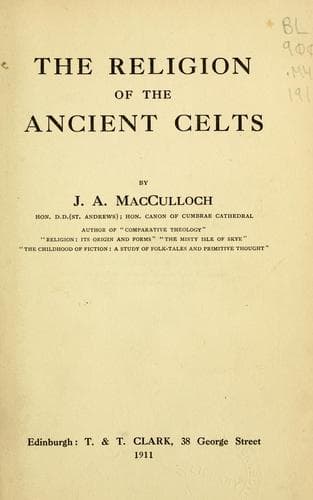
The Religion of the Ancient CeltsMacCulloch, J. A. (John Arnott)
Religion
The Religion of the Ancient Celts
MacCulloch, J. A. (John Arnott)
Celts -- Religion; Mythology, Celtic
The _taghairm_ of the Highlanders was a survival from pagan times. The
seer was usually bound in a cow's hide--the animal, it may be
conjectured, having been sacrificed in earlier times. He was left in a
desolate place, and while he slept spirits were supposed to inspire his
dreams.[870] Clothing in the skin of a sacrificial animal, by which the
person thus clothed is brought into contact with it and hence with the
divinity to which it is offered, or with the divine animal itself where
the victim is so regarded, is a widespread custom. Hence, in this Celtic
usage, contact with divinity through the hide would be expected to
produce enlightenment. For a like reason the Irish sacrificed a sheep
for the recovery of the sick, and clothed the patient in its skin.[871]
Binding the limbs of the seer is also a widespread custom, perhaps to
restrain his convulsions or to concentrate the psychic force.
Both among the continental and Irish Celts those who sought hidden
knowledge slept on graves, hoping to be inspired by the spirits of the
dead.[872] Legend told how, the full version of the _Táin_ having been
lost, Murgan the _Filé_ sang an incantation over the grave of Fergus mac
Roig. A cloud hid him for three days, and during that time the dead man
appeared and recited the saga to him.
In Ireland and the Highlands, divination by looking into the
shoulder-blade of a sheep was used to discover future events or things
happening at a distance, a survival from pagan times.[873] The scholiast
on Lucan describes the Druidic method of chewing acorns and then
prophesying, just as, in Ireland, eating nuts from the sacred hazels
round Connla's well gave inspiration.[874] The "priestesses" of Sena and
the "Druidesses" of the third century had the gift of prophecy, and it
was also ascribed freely to the _Filid_, the Druids, and to Christian
saints. Druids are said to have prophesied the coming of S. Patrick, and
similar prophecies are put in the mouths of Fionn and others, just as
Montezuma's priests foretold the coming of the Spaniards.[875] The word
used for such prophecies--_baile_, means "ecstasy," and it suggests that
the prophet worked himself into a frenzy and then fell into a trance, in
which he uttered his forecast. Prophecies were also made at the birth of
a child, describing its future career.[876] Careful attention was given
to the utterances of Druidic prophets, e.g. Medb's warriors postponed
their expedition for fifteen days, because the Druids told them they
would not succeed if they set out sooner.[877]
Public-domain text, read in full here on John Shaqi.
Reviews
Reviews
No reviews yet
Be the first to share your thoughts on this work.
Elsewhere in the archive
Join the Discussion
Join the discussion
Sign in to leave a comment or review.
Sign InorCreate an account