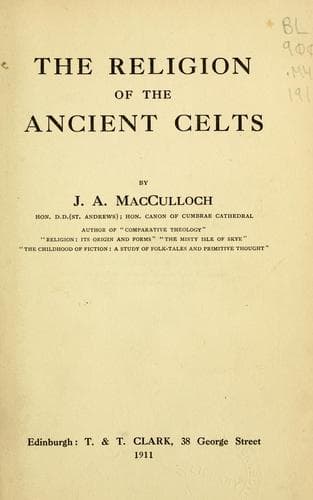
The Religion of the Ancient CeltsMacCulloch, J. A. (John Arnott)
Religion
The Religion of the Ancient Celts
MacCulloch, J. A. (John Arnott)
Celts -- Religion; Mythology, Celtic
Mythical personages or divinities are said in the Irish texts to have
stood on one leg, with one arm extended, and one eye closed, when
uttering prophecies or incantations, and this was doubtless an attitude
used by the seer.[878] A similar method is known elsewhere, and it may
have been intended to produce greater force. From this attitude may have
originated myths of beings with one arm, one leg, and one eye, like some
Fomorians or the _Fachan_ whose weird picture Campbell of Islay drew
from verbal descriptions.[879]
Early Celtic saints occasionally describe lapses into heathenism in
Ireland, not characterised by "idolatry," but by wizardry, dealing in
charms, and _fidlanna_, perhaps a kind of divination with pieces of
wood.[880] But it is much more likely that these had never really been
abandoned. They belong to the primitive element of religion and magic
which people cling to long after they have given up "idolatry."
FOOTNOTES:
[790] Cæsar, vi. 16.
[791] Rh[^y]s, _CB_{4} 68.
[792] Justin, xxvi. 2; Pomp. Mela, iii. 2.
[793] Diod. Sic. xxii. 9.
[794] See Jullian, 53.
[795] Servius on _Æneid_, iii. 57.
[796] Cæsar, vi. 16; Livy, xxxviii. 47; Diod. Sic. v. 32, xxxi. 13;
Athenæus, iv. 51; Dio Cass., lxii. 7.
[797] Diod. Sic, xxxiv. 13; Strabo, iv. 4; Orosius, v. 16; Schol. on
Lucan, Usener's ed. 32.
[798] Cæsar, vi. 16; Strabo, iv. 4; Diod. Sic. v. 32; Livy, xxxviii. 47.
[799] Mannhardt, _Baumkultus_, 529 f.
[800] Strabo, _ibid._ 4. 4.
[801] S. Aug. _de Civ. Dei_, vii. 19.
[802] Tac. _Ann._ xiv. 30; Strabo, iv. 4. 4.
[803] Suet. _Claud._ 25.
[804] Pomp. Mela, iii. 2. 18.
[805] Pliny, _HN_ xxx. 4. 13.
[806] Dio. Cass. lxii. 6.
[807] O'Curry, _MC_ ii. 222; Joyce, _SH_ i. ch. 9.
[808] _RC_ xvi. 35.
[809] _LL_ 213_b_.
[810] See p. 52, _supra_.
[811] See, however, accounts of reckless child sacrifices in Ellis,
_Polynesian Researches_, i. 252, and Westermarck, _Moral Ideas_, i. 397.
[812] O'Curry, _MC_ Intro, dcxli.
[813] _LU_ 126_a_. A folk-version is given by Larminie, _West Irish
Folk-Tales_, 139.
[814] _Book of Fermoy_, 89_a_.
[815] O'Curry, _MC_ Intro. dcxl, ii. 222.
[816] Adamnan, _Vita S. Col._ Reeve's ed. 288.
[817] Carmichael, _Carmina Gadelica_, ii. 317.
[818] Nennius, _Hist. Brit._ 40.
[819] Stokes, _TIG_ xli.; O'Curry, _MC_ ii. 9.
[820] Pliny, _HN_ xxx. 1. The feeding of Ethni, daughter of Crimthann,
on human flesh that she might sooner attain maturity may be an instance
of "medicinal cannibalism" (_IT_ iii. 363). The eating of parents among
the Irish, described by Strabo (iv. 5), was an example of "honorific
cannibalism." See my article "Cannibalism" in Hastings' _Encycl. of Rel.
and Ethics_, iii, 194.
[821] Diod. Sic. vi. 12; Paus. x. 22. 3; Amm. Marc. xxvii. 4; Livy,
xxiii. 24; Solin. xxii. 3.
[822] This custom continued in Ireland until Spenser's time.
[823] Leahy, i. 158; Giraldus, _Top. Hib._ iii. 22; Martin, 109.
Public-domain text, read in full here on John Shaqi.
Reviews
Reviews
No reviews yet
Be the first to share your thoughts on this work.
Elsewhere in the archive
Join the Discussion
Join the discussion
Sign in to leave a comment or review.
Sign InorCreate an account