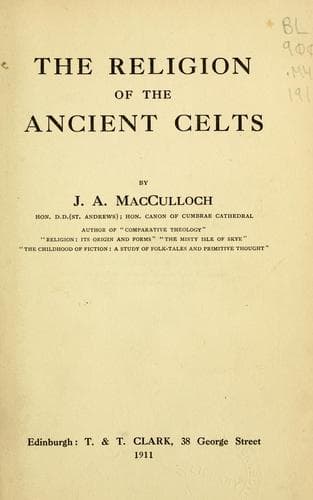
The Religion of the Ancient CeltsMacCulloch, J. A. (John Arnott)
Religion
The Religion of the Ancient Celts
MacCulloch, J. A. (John Arnott)
Celts -- Religion; Mythology, Celtic
[824] Sil. Ital. iv. 213; Diod. Sic. xiv. 115; Livy, x. 26; Strabo, iv.
4. 5; Miss Hull, 92.
[825] Diod. Sic. v. 29; Strabo, iv. 4. 5.
[826] D'Arbois, v. 11; Diod. Sic. v. 29; Strabo, _loc. cit._
[827] _Annals of the Four Masters_, 864; _IT_ i. 205.
[828] Sil. Ital. iv. 215, v. 652; Lucan, _Phar._ i. 447; Livy, xxiii.
24.
[829] See p. 71, _supra_; _CIL_ xii. 1077. A dim memory of head-taking
survived in the seventeenth century in Eigg, where headless skeletons
were found, of which the islanders said that an enemy had cut off their
heads (Martin, 277).
[830] Belloguet, _Ethnol. Gaul._ iii. 100.
[831] Sil. Ital. xiii. 482; Livy, xxiii. 24; Florus, i. 39.
[832] _ZCP_ i. 106.
[833] Loth, i. 90 f., ii. 218-219. Sometimes the weapons of a great
warrior had the same effect. The bows of Gwerthevyr were hidden in
different parts of Prydein and preserved the land from Saxon invasion,
until Gwrtheyrn, for love of a woman, dug them up (Loth, ii. 218-219).
[834] See p. 338, _infra_. In Ireland, the brain of an enemy was taken
from the head, mixed with lime, and made into a ball. This was allowed
to harden, and was then placed in the tribal armoury as a trophy.
[835] _L'Anthropologie_, xii. 206, 711. Cf. the English tradition of the
"Holy Mawle," said to have been used for the same purpose. Thorns,
_Anecdotes and Traditions_, 84.
[836] Arrian, _Cyneg._ xxxiii.
[837] Cæsar, vi. 17; Orosius, v. 16. 6.
[838] D'Arbois, i. 155.
[839] Curtin, _Tales of the Fairies_, 72; _Folk-Lore_, vii. 178-179.
[840] Mitchell, _Past in the Present_, 275.
[841] Mitchell, _op. cit._ 271 f.
[842] Cook, _Folk-Lore_, xvii. 332.
[843] Mitchell, _loc. cit._ 147. The corruption of "Maelrubha" to
"Maree" may have been aided by confusing the name with _mo_ or _mhor
righ_.
[844] Mitchell, _loc. cit._; Moore, 92, 145; Rh[^y]s, _CFL_ i. 305;
Worth, _Hist. of Devonshire_, 339; Dalyell, _passim_.
[845] Livy, xxiii. 24.
[846] Sébillot, ii. 166-167; _L'Anthrop._ xv. 729.
[847] Carmichael, _Carm. Gad._ i. 163.
[848] Martin, 28. A scribe called "Sonid," which might be the equivalent
of "Shony," is mentioned in the Stowe missal (_Folk-Lore_, 1895).
[849] Campbell, _Superstitions_, 184 f; _Waifs and Strays of Celtic
Trad._ ii. 455.
[850] Aelian, xvii. 19.
[851] Tacitus, _Ann._ xiv. 30; Dio Cass. lxii. 6.
[852] Appian, _Celtica_, 8; Livy, xxi. 28, xxxviii. 17, x. 26.
[853] Livy, v. 38, vii. 23; Polybius, ii. 29. Cf. Watteville, _Le cri de
guerre chez les differents peuples_, Paris, 1889.
[854] Livy, v. 38.
[855] Appian, vi. 53; Muret et Chabouillet, _Catalogue des monnaies
gauloises_, 6033 f., 6941 f.
[856] Diod. v. 31; Justin, xxvi. 2, 4; Cicero, _de Div._ ii. 36, 76;
Tac. _Ann._ xiv. 30; Strabo, iii. 3. 6.
[857] Dio Cass. lxii. 6.
[858] Reinach, _Catal. Sommaire_, 31; Pseudo-Plutarch, _de Fluviis_, vi.
4; _Mirab. Auscult._ 86.
[859] Strabo, iv. 4. 6.
Public-domain text, read in full here on John Shaqi.
Reviews
Reviews
No reviews yet
Be the first to share your thoughts on this work.
Elsewhere in the archive
Join the Discussion
Join the discussion
Sign in to leave a comment or review.
Sign InorCreate an account