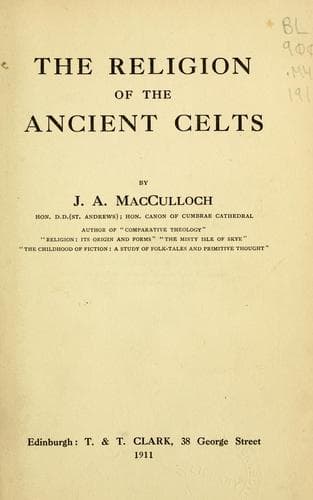
The Religion of the Ancient CeltsMacCulloch, J. A. (John Arnott)
Religion
The Religion of the Ancient Celts
MacCulloch, J. A. (John Arnott)
Celts -- Religion; Mythology, Celtic
In some cases _geasa_ were based on ideas of right and wrong, honour or
dishonour, or were intended to cause avoidance of unlucky days. Others
are unintelligible to us. The largest number of _geasa_ concerned kings
and chiefs, and are described, along with their corresponding
privileges, in the _Book of Rights_. Some of the _geasa_ of the king of
Connaught were not to go to an assembly of women at Leaghair, not to sit
in autumn on the sepulchral mound of the wife of Maine, not to go in a
grey-speckled garment on a grey-speckled horse to the heath of Cruachan,
and the like.[883] The meaning of these is obscure, but other examples
are more obvious and show that all alike corresponded to the tabus
applying to kings in primitive societies, who are often magicians,
priests, or even divine representatives. On them the welfare of the
tribe and the making of rain or sunshine, and the processes of growth
depend. They must therefore be careful of their actions, and hence they
are hedged about with tabus which, however unmeaning, have a direct
connection with their powers. Out of such conceptions the Irish kingly
_geasa_ arose. Their observance made the earth fruitful, produced
abundance and prosperity, and kept both the king and his land from
misfortune. In later times these were supposed to be dependent on the
"goodness" or the reverse of the king, but this was a departure from the
older idea, which is clearly stated in the _Book of Rights_.[884] The
kings were divinities on whom depended fruitfulness and plenty, and who
must therefore submit to obey their _geasa_. Some of their prerogatives
seem also to be connected with this state of things. Thus they might eat
of certain foods or go to certain places on particular days.[885] In
primitive societies kings and priests often prohibit ordinary mortals
from eating things which they desire for themselves by making them
_tabu_, and in other cases the fruits of the earth can only be eaten
after king or priest has partaken of them ceremonially. This may have
been the case in Ireland. The privilege relating to places may have
meant that these were sacred and only to be entered by the king at
certain times and in his sacred capacity.
As a reflection from this state of things, the heroes of the sagas,
Cúchulainn and Fionn, had numerous _geasa_ applicable to themselves,
some of them religious, some magical, others based on primitive ideas of
honour, others perhaps the invention of the narrators.[886]
Public-domain text, read in full here on John Shaqi.
Reviews
Reviews
No reviews yet
Be the first to share your thoughts on this work.
Elsewhere in the archive
Join the Discussion
Join the discussion
Sign in to leave a comment or review.
Sign InorCreate an account