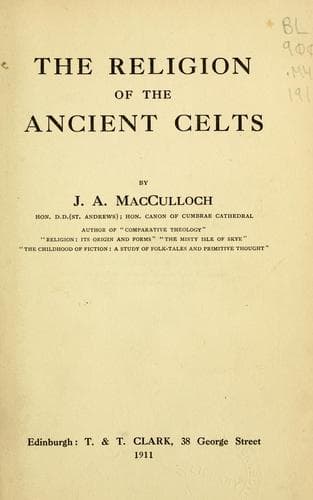
The Religion of the Ancient CeltsMacCulloch, J. A. (John Arnott)
Religion
The Religion of the Ancient Celts
MacCulloch, J. A. (John Arnott)
Celts -- Religion; Mythology, Celtic
_Geasa_, whether in the sense of tabus or of obligations, could be
imposed by any one, and must be obeyed, for disobedience produced
disastrous effects. Probably the obligation was framed as an incantation
or spell, and the power of the spell being fully believed in, obedience
would follow as a matter of course.[887] Examples of such _geasa_ are
numerous in Irish literature. Cúchulainn's father-in-law put _geasa_ on
him that he should know no rest until he found out the cause of the
exile of the sons of Doel. And Grainne put _geasa_ on Diarmaid that he
should elope with her, and this he did, though the act was repugnant to
him.
Among savages the punishment which is supposed to follow tabu-breaking
is often produced through auto-suggestion when a tabu has been
unconsciously infringed and this has afterwards been discovered. Fear
produces the result which is feared. The result is believed, however, to
be the working of divine vengeance. In the case of Irish _geasa_,
destruction and death usually followed their infringement, as in the
case of Diarmaid and Cúchulainn. But the best instance is found in the
tale of _The Destruction of Da Derga's Hostel_, in which the _síd_-folk
avenge themselves for Eochaid's action by causing the destruction of his
descendant Conaire, who is forced to break his _geasa_. These are first
minutely detailed; then it is shown how, almost in spite of himself,
Conaire was led on to break them, and how, in the sequel, his tragic
death occurred.[888] Viewed in this light as the working of divine
vengeance to a remote descendant of the offender by forcing him to break
his tabus, the story is one of the most terrible in the whole range of
Irish literature.
FOOTNOTES:
[881] The religious interdictions mentioned by Cæsar (vi. 13) may be
regarded as tabus, while the spoils of war placed in a consecrated place
(vi. 18), and certain animals among the Britons (v. 12), were clearly
under tabu.
[882] Joyce, _OCR_ 332 f.
[883] _Book of Rights_, ed. O'Donovan, 5.
[884] _Book of Rights_, 7.
[885] Ibid. 3 f.
[886] _LL_ 107; O'Grady, ii. 175.
[887] In Highland tales _geasa_ is translated "spells."
[888] _RC_ xxii. 27 f. The story of _Da Choca's Hostel_ has for its
subject the destruction of Cormac through breaking his _geasa_ (_RC_
xxi. 149 f.).
CHAPTER XVIII.
FESTIVALS.
Public-domain text, read in full here on John Shaqi.
Reviews
Reviews
No reviews yet
Be the first to share your thoughts on this work.
Elsewhere in the archive
Join the Discussion
Join the discussion
Sign in to leave a comment or review.
Sign InorCreate an account