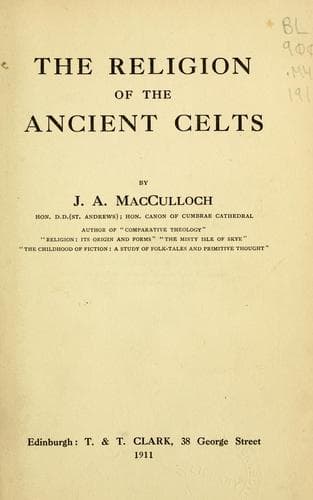
The Religion of the Ancient CeltsMacCulloch, J. A. (John Arnott)
Religion
The Religion of the Ancient Celts
MacCulloch, J. A. (John Arnott)
Celts -- Religion; Mythology, Celtic
The diffusion of the Ambicatus legend would help to preserve unity by
recalling the mythic greatness of the past. The Boii and Insubri
appealed to transalpine Gauls for aid by reminding them of the deeds of
their ancestors.[50] Nor would the Druids omit to infuse into their
pupils' minds the sentiment of national greatness. For this and for
other reasons, the Romans, to whom "the sovereignty of all Gaul" was an
obnoxious watch-word, endeavoured to suppress them.[51] But the Celts
were too widely scattered ever to form a compact empire.[52] The Roman
empire extended itself gradually in the consciousness of its power; the
cohesion of the Celts in an empire or under one king was made impossible
by their migrations and diffusion. Their unity, such as it was, was
broken by the revolt of the Teutonic tribes, and their subjugation was
completed by Rome. The dreams of wide empire remained dreams. For the
Celts, in spite of their vigour, have been a race of dreamers, their
conquests in later times, those of the spirit rather than of the mailed
fist. Their superiority has consisted in imparting to others their
characteristics; organised unity and a vast empire could never be
theirs.
FOOTNOTES:
[6] Ripley, _Races of Europe_; Wilser, _L'Anthropologie_, xiv. 494;
Collignon, _ibid._ 1-20; Broca, _Rev. d'Anthrop._ ii. 589 ff.
[7] Sergi, _The Mediterranean Race_, 241 ff., 263 ff.
[8] Keane, _Man, Past and Present_, 511 ff., 521, 528.
[9] Broca, _Mem. d'Anthrop._ i. 370 ff. Hovelacque thinks, with Keane,
that the Gauls learned Celtic from the dark round-heads. But Galatian
and British Celts, who had never been in contact with the latter, spoke
Celtic. See Holmes, _Cæsar's Conquest of Gaul_, 311-312.
[10] Cæsar, i. 1; Collignon, _Mem. Soc. d'Anthrop. de Paris_, 3{me} ser.
i. 67.
[11] Cæsar, i. 1.
[12] Cæsar, ii. 30.
[13] Cæsar, i. 1; Strabo, iv. 1. 1.
[14] Cf. Holmes, 295; Beddoe, _Scottish Review_, xix. 416.
[15] D'Arbois, _Les Celtes_, 175.
[16] Cæsar, ii. 4; Strabo, vii. 1. 2. Germans are taller and fairer than
Gauls; Tacitus, _Agric._ ii. Cf. Beddoe, _JAI_ xx. 354-355.
[17] D'Arbois, _PH_ ii. 374. Welsh Gwydion and Teutonic Wuotan may have
the same root, see p. 105. Celtic Taranis has been compared to Donar,
but there is no connection, and Taranis was not certainly a thunder-god.
Much of the folk-religion was alike, but this applies to folk-religion
everywhere.
[18] D'Arbois, ii. 251.
[19] Beddoe, _L'Anthropologie_, v. 516. Tall, fair, and highly
brachycephalic types are still found in France, _ibid._ i. 213;
Bortrand-Reinach, _Les Celtes_, 39.
[20] Beddoe, 516; _L'Anthrop._, v. 63; Taylor, 81; Greenwell, _British
Barrows_, 680.
[21] _Fort. Rev._ xvi. 328; _Mem. of London Anthr. Soc._, 1865.
[22] Ripley, 309; Sergi, 243; Keane, 529; Taylor, 112.
[23] Taylor, 122, 295.
[24] The Walloons are both dark and fair.
[25] D'Arbois, _PH_ ii. 132.
Public-domain text, read in full here on John Shaqi.
Reviews
Reviews
No reviews yet
Be the first to share your thoughts on this work.
Join the Discussion
Join the discussion
Sign in to leave a comment or review.
Sign InorCreate an account