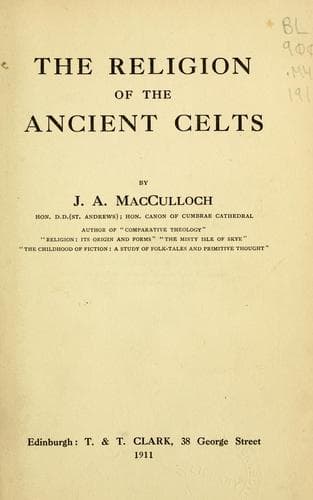
The Religion of the Ancient CeltsMacCulloch, J. A. (John Arnott)
Religion
The Religion of the Ancient Celts
MacCulloch, J. A. (John Arnott)
Celts -- Religion; Mythology, Celtic
Though the sacrificial victim had come to be regarded as an offering to
the powers of blight, he may once have represented a divinity of growth
or, in earlier times, the corn-spirit. Such a victim was slain at
harvest, and harvest is often late in northern Celtic regions, while the
slaying was sometimes connected not with the harvest field, but with the
later threshing. This would bring it near the Samhain festival. The
slaying of the corn-spirit was derived from the earlier slaying of a
tree or vegetation-spirit embodied in a tree and also in a human or
animal victim. The corn-spirit was embodied in the last sheaf cut as
well as in an animal or human being.[909] This human victim may have
been regarded as a king, since in late popular custom a mock king is
chosen at winter festivals.[910] In other cases the effigy of a saint is
hung up and carried round the different houses, part of the dress being
left at each. The saint has probably succeeded to the traditional ritual
of the divine victim.[911] The primitive period in which the corn-spirit
was regarded as female, with a woman as her human representative, is
also recalled in folk-custom. The last sheaf is called the Maiden or the
Mother, while, as in Northamptonshire, girls choose a queen on S.
Catharine's day, November 26th, and in some Christmas pageants "Yule's
wife," as well as Yule, is present, corresponding to the May queen of
the summer festival.[912] Men also masqueraded as women at the Calends.
The dates of these survivals may be explained by that dislocation of the
Samhain festival already pointed out. This view of the Samhain human
sacrifices is supported by the Irish offerings to the Fomorians--gods of
growth, later regarded as gods of blight, and to Cromm Cruaich, in both
cases at Samhain.[913] With the evolution of religious thought, the
slain victim came to be regarded as an offering to evil powers.
This aspect of Samhain, as a festival to promote and assist festivity,
is further seen in the belief in the increased activity of fairies at
that time. In Ireland, fairies are connected with the Tuatha Dé Danann,
the divinities of growth, and in many folk-tales they are associated
with agricultural processes. The use of evergreens at Christmas is
perhaps also connected with the carrying of them round the fields in
older times, as an evidence that the life of nature was not
extinct.[914]
Public-domain text, read in full here on John Shaqi.
Reviews
Reviews
No reviews yet
Be the first to share your thoughts on this work.
Elsewhere in the archive
Join the Discussion
Join the discussion
Sign in to leave a comment or review.
Sign InorCreate an account