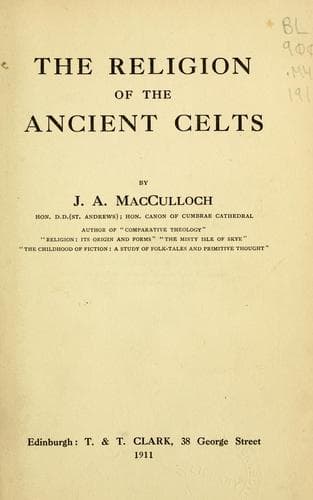
The Religion of the Ancient CeltsMacCulloch, J. A. (John Arnott)
Religion
The Religion of the Ancient Celts
MacCulloch, J. A. (John Arnott)
Celts -- Religion; Mythology, Celtic
Samhain may thus be regarded as, in origin, an old pastoral and
agricultural festival, which in time came to be looked upon as affording
assistance to the powers of growth in their conflict with the powers of
blight. Perhaps some myth describing this combat may lurk behind the
story of the battle of Mag-tured fought on Samhain between the Tuatha Dé
Danann and the Fomorians. While the powers of blight are triumphant in
winter, the Tuatha Déa are represented as the victors, though they
suffer loss and death. Perhaps this enshrines the belief in the
continual triumph of life and growth over blight and decay, or it may
arise from the fact that Samhain was both a time of rejoicing for the
ingathered harvest, and of wailing for the coming supremacy of winter
and the reign of the powers of blight.
BELTANE.
In Cormac's _Glossary_ and other texts, "Beltane" is derived from
_bel-tene_, "a goodly fire," or from _bel-dine_, because newly-born
(_dine_) cattle were offered to Bel, an idol-god.[915] The latter is
followed by those who believe in a Celtic Belus, connected with Baal. No
such god is known, however, and the god Belenos is in no way connected
with the Semitic divinity. M. D'Arbois assumes an unknown god of death,
Beltene (from _beltu_, "to die"), whose festival Beltane was.[916] But
Beltane was a festival of life, of the sun shining in his strength. Dr.
Stokes gives a more acceptable explanation of the word. Its primitive
form was _belo-te_[_p_]_niâ_, from _belo-s_, "clear," "shining," the
root of the names Belenos and Belisama, and _te_[_p_]_nos_, "fire." Thus
the word would mean something like "bright fire," perhaps the sun or the
bonfire, or both.[917]
The folk-survivals of the Beltane and Midsummer festivals show that both
were intended to promote fertility.
One of the chief ritual acts at Beltane was the kindling of bonfires,
often on hills. The house-fires in the district were often extinguished,
the bonfire being lit by friction from a rotating wheel--the German
"need-fire."[918] The fire kept off disease and evil, hence cattle were
driven through it, or, according to Cormac, between two fires lit by
Druids, in order to keep them in health during the year.[919] Sometimes
the fire was lit beneath a sacred tree, or a pole covered with greenery
was surrounded by the fuel, or a tree was burned in the fire.[920] These
trees survive in the Maypole of later custom, and they represented the
vegetation-spirit, to whom also the worshippers assimilated themselves
by dressing in leaves. They danced sunwise round the fire or ran through
the fields with blazing branches or wisps of straw, imitating the course
of the sun, and thus benefiting the fields.[921] For the same reason the
tree itself was probably borne through the fields. Houses were decked
with boughs and thus protected by the spirit of vegetation.[922]
Public-domain text, read in full here on John Shaqi.
Reviews
Reviews
No reviews yet
Be the first to share your thoughts on this work.
Elsewhere in the archive
Join the Discussion
Join the discussion
Sign in to leave a comment or review.
Sign InorCreate an account