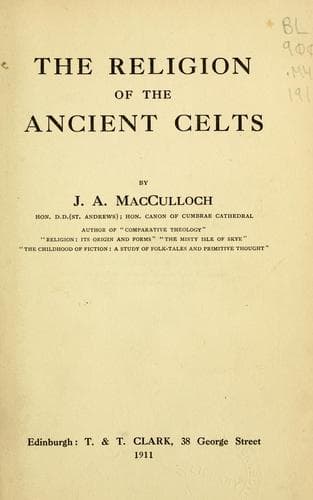
The Religion of the Ancient CeltsMacCulloch, J. A. (John Arnott)
Religion
The Religion of the Ancient Celts
MacCulloch, J. A. (John Arnott)
Celts -- Religion; Mythology, Celtic
The ritual of the Midsummer festival did not materially differ from that
of Beltane, and as folk-survivals show, it was practised not only by the
Celts, but by many other European peoples. It was, in fact, a primitive
nature festival such as would readily be observed by all under similar
psychic conditions and in like surroundings. A bonfire was again the
central rite of this festival, the communal nature of which is seen in
the fact that all must contribute materials to it. In local survivals,
mayor and priest, representing the earlier local chief and priest, were
present, while a service in church preceded the procession to the scene
of the bonfire. Dancing sunwise round the fire to the accompaniment of
songs which probably took the place of hymns or tunes in honour of the
Sun-god, commonly occurred, and by imitating the sun's action, may have
been intended to make it more powerful. The livelier the dance the
better would be the harvest.[930] As the fire represented the sun, it
possessed the purifying and invigorating powers of the sun; hence
leaping through the fire preserved from disease, brought prosperity, or
removed barrenness. Hence also cattle were driven through the fire. But
if any one stumbled as he leaped, ill-luck was supposed to follow him.
He was devoted to the _fadets_ or spirits,[931] and perhaps, like the
"devoted" Beltane victim, he may formerly have been sacrificed. Animal
sacrifices are certainly found in many survivals, the victims being
often placed in osier baskets and thrown into the fire. In other
districts great human effigies of osier were carried in procession and
burned.[932]
The connection of such sacrifices with the periodical slaying of a
representative of the vegetation-spirit has been maintained by Mannhardt
and Dr. Frazer.[933] As has been seen, periodic sacrifices for the
fertility of the land are mentioned by Cæsar, Strabo, and Diodorus,
human victims and animals being enclosed in an osier image and
burned.[934] These images survive in the osier effigies just referred
to, while they may also be connected with the custom of decking the
human representatives of the spirit of vegetation in greenery. The
holocausts may be regarded as extensions of the earlier custom of
slaying one victim, the incarnation of a vegetation-spirit. This slaying
was gradually regarded as sacrificial, but as the beneficial effect of
the sacrifice on growth was still believed in, it would naturally be
thought that still better effects would be produced if many victims were
offered. The victims were burned in a fire representing the sun, and
vegetation was thus doubly benefited, by the victims and by the sun-god.
Public-domain text, read in full here on John Shaqi.
Reviews
Reviews
No reviews yet
Be the first to share your thoughts on this work.
Elsewhere in the archive
Join the Discussion
Join the discussion
Sign in to leave a comment or review.
Sign InorCreate an account