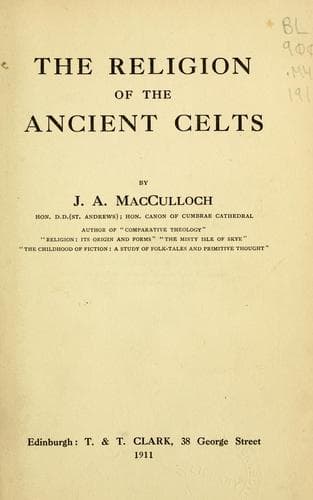
The Religion of the Ancient CeltsMacCulloch, J. A. (John Arnott)
Religion
The Religion of the Ancient Celts
MacCulloch, J. A. (John Arnott)
Celts -- Religion; Mythology, Celtic
The oldest conception of the vegetation-spirit was that of a tree-spirit
which had power over rain, sunshine, and every species of fruitfulness.
For this reason a tree had a prominent place both in the Beltane and
Midsummer feasts. It was carried in procession, imparting its benefits
to each house or field. Branches of it were attached to each house for
the same purpose. It was then burned, or it was set up to procure
benefits to vegetation during the year and burned at the next Midsummer
festival.[935] The sacred tree was probably an oak, and, as has been
seen, the mistletoe rite probably took place on Midsummer eve, as a
preliminary to cutting down the sacred tree and in order to secure the
life or soul of the tree, which must first be secured before the tree
could be cut down. The life of the tree was in the mistletoe, still
alive in winter when the tree itself seemed to be dead. Such beliefs as
this concerning the detachable soul or life survive in _Märchen_, and
are still alive among savages.[936]
Folk-survivals show that a human or an animal representative of the
vegetation-spirit, brought into connection with the tree, was also slain
or burned along with the tree.[937] Thus the cutting of the mistletoe
would be regarded as a preliminary to the slaying of the human victim,
who, like the tree, was the representative of the spirit of vegetation.
The bonfire representing the sun, and the victims, like the tree,
representing the spirit of vegetation, it is obvious why the fire had
healing and fertilising powers, and why its ashes and the ashes or the
flesh of the victims possessed the same powers. Brands from the fire
were carried through the fields or villages, as the tree had been, or
placed on the fields or in houses, where they were carefully preserved
for a year. All this aided growth and prosperity, just as the smoke of
the fire, drifting over the fields, produced fertility. Ashes from the
fire, and probably the calcined bones or even the flesh of the victims,
were scattered on the fields or preserved and mixed with the seed corn.
Again, part of the flesh may have been eaten sacramentally, since, as
has been seen, Pliny refers to the belief of the Celts in the eating of
human flesh as most wholesome.
Public-domain text, read in full here on John Shaqi.
Reviews
Reviews
No reviews yet
Be the first to share your thoughts on this work.
Elsewhere in the archive
Join the Discussion
Join the discussion
Sign in to leave a comment or review.
Sign InorCreate an account