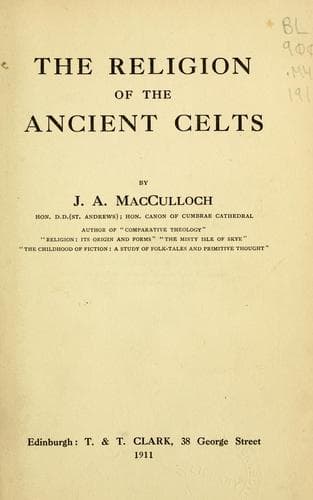
The Religion of the Ancient CeltsMacCulloch, J. A. (John Arnott)
Religion
The Religion of the Ancient Celts
MacCulloch, J. A. (John Arnott)
Celts -- Religion; Mythology, Celtic
Due observance of the feast produced abundance of corn, fruit, milk, and
fish. Probably the ritual observed included the preservation of the last
sheaf as representing the corn-spirit, giving some of it to the cattle
to strengthen them, and mingling it with next year's corn to impart to
it the power of the corn-spirit. It may also have included the slaying
of an animal or human incarnation of the corn-spirit, whose flesh and
blood quickened the soil and so produced abundance next year, or, when
partaken of by the worshippers, brought blessings to them. To neglect
such rites, abundant instances of which exist in folk-custom, would be
held to result in scarcity. This would also explain, as already
suggested, why the festival was associated with the death of Tailtiu or
of Carman. The euhemerised queen-goddess Tailtiu and the woman Carman
had once been corn-goddesses, evolved from more primitive corn-spirits,
and slain at the feast in their female representatives. The story of
their death and burial at the festival was a dim memory of this ancient
rite, and since the festival was also connected with the sun-god Lug, it
was easy to bring him into relationship with the earlier goddess.
Elsewhere the festival, in its memorial aspect, was associated with a
king, probably because male victims had come to be representatives of a
corn-god who had taken the place of the goddess.
* * * * *
Some of the ritual of these festivals is illustrated by scattered
notices in classical writers, and on the whole they support our theory
that the festivals originated in a female cult of spirits or goddesses
of fertility. Strabo speaks of sacrifices offered to Demeter and Kore,
according to the ritual followed at Samothrace, in an island near
Britain, i.e. to native goddesses equated with them. He also describes
the ritual of the Namnite women on an island in the Loire. They are
called Bacchantes because they conciliated Bacchus with mysteries and
sacrifices; in other words, they observed an orgiastic cult of a god
equated with Bacchus. No man must set foot on the island, but the women
left it once a year for intercourse with the other sex. Once a year the
temple of the god was unroofed, and roofed again before sunset. If any
woman dropped her load of materials (and it was said this always
happened), she was torn in pieces and her limbs carried round the
temple.[944] Dionysius Periegetes says the women were crowned with ivy,
and celebrated their mysteries by night in honour of Earth and
Proserpine with great clamour.[945] Pliny also makes a reference to
British rites in which nude women and girls took part, their bodies
stained with woad.[946]
Public-domain text, read in full here on John Shaqi.
Reviews
Reviews
No reviews yet
Be the first to share your thoughts on this work.
Elsewhere in the archive
Join the Discussion
Join the discussion
Sign in to leave a comment or review.
Sign InorCreate an account