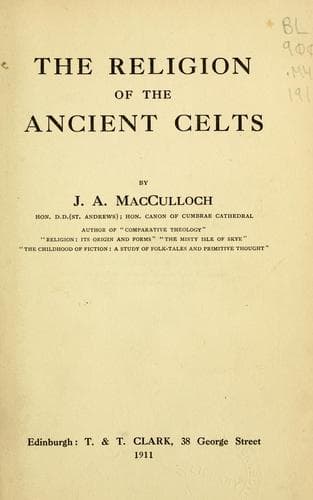
The Religion of the Ancient CeltsMacCulloch, J. A. (John Arnott)
Religion
The Religion of the Ancient Celts
MacCulloch, J. A. (John Arnott)
Celts -- Religion; Mythology, Celtic
The 1st of August, coming midway between Beltane and Samhain, was an
important festival among the Celts. In Christian times the day became
Lammas, but its name still survives in Irish as Lugnasad, in Gaelic as
Lunasdal or Lunasduinn, and in Manx as Laa Luanys, and it is still
observed as a fair or feast in many districts. Formerly assemblies at
convenient centres were held on this day, not only for religious
purposes, but for commerce and pleasure, both of these being of course
saturated with religion. "All Ireland" met at Taillti, just as "all
Gaul" met at Lugudunum, "Lug's town," or Lyons, in honour of Augustus,
though the feast there had formerly been in honour of the god
Lugus.[941] The festival was here Romanised, as it was also in Britain,
where its name appears as _Goel-aoust_, _Gul-austus_, and _Gwyl Awst_,
now the "August feast," but formerly the "feast of Augustus," the name
having replaced one corresponding to Lugnasad.[942]
Cormac explains the name Lugnasad as a festival of Lugh mac Ethlenn,
celebrated by him in the beginning of autumn, and the _Rennes
Dindsenchas_ accounts for its origin by saying that Lug's foster-mother,
Tailtiu, having died on the Calends of August, he directed an assembly
for lamentation to be held annually on that day at her tomb.[943] Lug is
thus the founder of his own festival, for that it was his, and not
Tailtiu's, is clear from the fact that his name is attached to it. As
Lammas was a Christian harvest thanksgiving, so also was Lugnasad a
pagan harvest feast, part of the ritual of which passed over to Samhain.
The people made glad before the sun-god--Lug perhaps having that
character--who had assisted them in the growth of the things on which
their lives depended. Marriages were also arranged at this feast,
probably because men had now more leisure and more means for entering
upon matrimony. Possibly promiscuous love-making also occurred as a
result of the festival gladness, agricultural districts being still
notoriously immoral. Some evidence points to the connection of the feast
with Lug's marriage, though this has been allegorised into his wedding
the "sovereignty of Erin." Perhaps we have here a hint of the rite of
the sacred marriage, for the purpose of magically fertilising the fields
against next year's sowing.
Public-domain text, read in full here on John Shaqi.
Reviews
Reviews
No reviews yet
Be the first to share your thoughts on this work.
Elsewhere in the archive
Join the Discussion
Join the discussion
Sign in to leave a comment or review.
Sign InorCreate an account