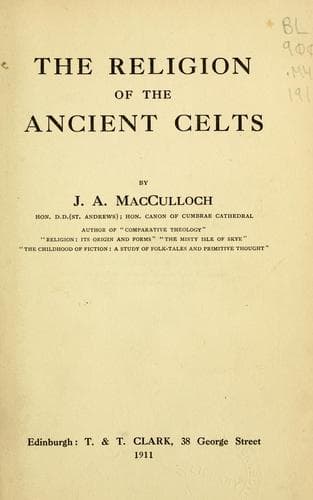
The Religion of the Ancient CeltsMacCulloch, J. A. (John Arnott)
Religion
The Religion of the Ancient Celts
MacCulloch, J. A. (John Arnott)
Celts -- Religion; Mythology, Celtic
There is thus abundant evidence of the cult of fertility, vegetation,
and corn-spirits, who tended to become divinities, male or female. Here
and there, through conservatism, the cult remained in the hands of
women, but more generally it had become a ritual in which both men and
women took part--that of the great agricultural festivals. Where a
divinity had taken the place of the vaguer spirits, her image, like that
of Berecynthia, was used in the ritual, but the image was probably the
successor of the tree which embodied the vegetation-spirit, and was
carried through the fields to fertilise them. Similar processions of
images, often accompanied by a ritual washing of the image in order to
invigorate the divinity, or, as in the similar May-day custom, to
produce rain, are found in the Teutonic cult of Nerthus, the Phrygian of
Cybele, the Hindu of Bhavani, and the Roman ritual of the Bona Dea. The
image of Berecynthia was thus probably washed also. Washing the images
of saints, usually to produce rain, has sometimes taken the place of the
washing of a divine image, and similarly the relics of a saint are
carried through a field, as was the tree or image. The community at Iona
perambulated a newly sown field with S. Columba's relics in time of
drought, and shook his tunic three times in the air, and were rewarded
by a plentiful rain, and later, by a bounteous harvest.[951]
Many of these local cults were pre-Celtic, but we need not therefore
suppose that the Celts, or the Aryans as a whole, had no such
cults.[952] The Aryans everywhere adopted local cults, but this they
would not have done if, as is supposed, they had themselves outgrown
them. The cults were local, but the Celts had similar local cults, and
easily accepted those of the people they conquered. We cannot explain
the persistence of such primitive cults as lie behind the great Celtic
festivals, both in classical times and over the whole area of Europe
among the peasantry, by referring them solely to a pre-Aryan folk. They
were as much Aryan as pre-Aryan. They belong to those unchanging strata
of religion which have so largely supplied the soil in which its later
and more spiritual growths have flourished. And among these they still
emerge, unchanged and unchanging, like the gaunt outcrops of some
ancient rock formation amid rich vegetation and fragrant flowers.
FOOTNOTES:
[889] Pliny, xvi. 45; Cæsar, vi. 18. See my article "Calendar (Celtic)"
in Hastings' _Encyclopædia of Rel. and Ethics_, iii. 78 f., for a full
discussion of the problems involved.
[890] O'Donovan, _Book of Rights_, Intro. lii f.
[891] O'Donovan, li.; Bertrand, 105; Keating, 300.
[892] Samhain may mean "summer-end," from _sam_, "summer," and _fuin_,
"sunset" or "end," but Dr. Stokes (_US_ 293) makes _samani_- mean
"assembly," i.e. the gathering of the people to keep the feast.
[893] Keating, 125, 300.
[894] See MacBain, _CM_ ix. 328.
Public-domain text, read in full here on John Shaqi.
Reviews
Reviews
No reviews yet
Be the first to share your thoughts on this work.
Elsewhere in the archive
Join the Discussion
Join the discussion
Sign in to leave a comment or review.
Sign InorCreate an account