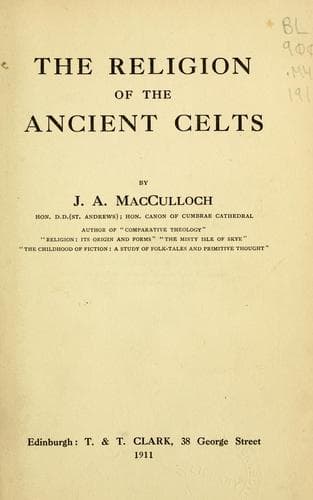
The Religion of the Ancient CeltsMacCulloch, J. A. (John Arnott)
Religion
The Religion of the Ancient Celts
MacCulloch, J. A. (John Arnott)
Celts -- Religion; Mythology, Celtic
[895] Brand, i. 390; Ramsay, _Scotland and Scotsmen in the Eighteenth
Century_, ii. 437; _Stat. Account_, xi. 621.
[896] Hazlitt, 297-298, 340; Campbell, _Witchcraft_, 285 f.
[897] Curtin, 72.
[898] Fitzgerald, _RC_ vi. 254.
[899] See Chambers, _Mediæval Stage_, App. N, for the evidence from
canons and councils regarding these.
[900] Tille, _Yule and Christmas_, 96.
[901] Chambers, _Popular Rhymes_, 166.
[902] Hutchinson, _View of Northumberland_, ii. 45; Thomas, _Rev. de
l'Hist. des Rel._ xxxviii. 335 f.
[903] _Patrol. Lot._ xxxix. 2001.
[904] _IT_ i. 205; _RC_ v. 331; Leahy, i. 57.
[905] See p. 169, _supra_.
[906] The writer has himself seen such bonfires in the Highlands. See
also Hazlitt, 298; Pennant, _Tour_, ii. 47; Rh[^y]s, _HL_ 515, _CFL_ i.
225-226. In Egyptian mythology, Typhon assailed Horus in the form of a
black swine.
[907] Keating, 300.
[908] Joyce, _SH_ ii. 556; _RC_ x. 214, 225, xxiv. 172; O'Grady, ii.
374; _CM_ ix. 209.
[909] See Mannhardt, _Mythol. Forschung._ 333 f.; Frazer, _Adonis_,
_passim_; Thomas, _Rev. de l'Hist. des Rel._ xxxviii. 325 f.
[910] Hazlitt, 35; Chambers, _Mediæval Stage_, i. 261.
[911] Chambers, _Book of Days_, ii. 492; Hazlitt, 131.
[912] Hazlitt, 97; Davies, _Extracts from Munic. Records of York_, 270.
[913] See p. 237, _supra_; _LL_ 16, 213.
[914] Chambers, _Med. Stage_, i. 250 f.
[915] Cormac, _s.v._ "Belltaine," "Bel"; _Arch. Rev._ i. 232.
[916] D'Arbois, ii. 136.
[917] Stokes, _US_ 125, 164. See his earlier derivation, dividing the
word into _belt_, connected with Lithuan. _baltas_, "white," and _aine_,
the termination in _sechtmaine_, "week" (_TIG_ xxxv.).
[918] Need-fire (Gael. _Teinne-eiginn_, "necessity fire") was used to
kindle fire in time of cattle plague. See Grimm, _Teut. Myth._ 608 f.;
Martin, 113; Jamieson's _Dictionary_, _s.v._ "neidfyre."
[919] Cormac, _s.v._; Martin, 105, says that the Druids extinguished all
fires until their dues were paid. This may have been a tradition in the
Hebrides.
[920] Joyce, _PN_ i. 216; Hone, _Everyday Book_, i. 849, ii. 595.
[921] Pennant, _Tour in Scotland_, i. 291.
[922] Hazlitt, 339, 397.
[923] Hone, _Everyday Book_, ii. 595. See p. 215, _supra_.
[924] Sinclair, _Stat. Account_, xi. 620.
[925] Martin, 105.
[926] For these usages see Ramsay, _Scotland and Scotsmen in the
Eighteenth Century_, ii. 439 f.; Sinclair, _Stat. Account_, v. 84, xi.
620, xv. 517. For the sacramental and sacrificial use of similar loaves,
see Frazer, _Golden Bough_{2}, i. 94, ii. 78; Grimm, _Teut. Myth._ iii.
1239 f.
[927] _New Stat. Account_, Wigtownshire, 208; Hazlitt, 38, 323, 340.
[928] See Miss Owen, _Folk-lore of the Musquakie Indians_, 50; Frazer,
_Golden Bough_{2}, ii. 205.
Public-domain text, read in full here on John Shaqi.
Reviews
Reviews
No reviews yet
Be the first to share your thoughts on this work.
Elsewhere in the archive
Join the Discussion
Join the discussion
Sign in to leave a comment or review.
Sign InorCreate an account