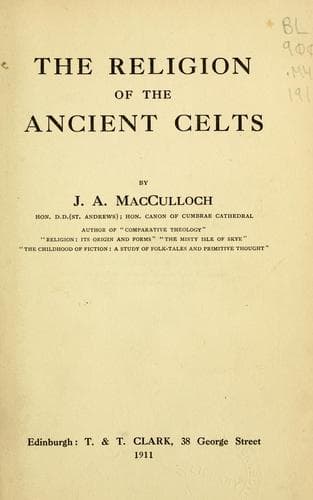
The Religion of the Ancient CeltsMacCulloch, J. A. (John Arnott)
Religion
The Religion of the Ancient Celts
MacCulloch, J. A. (John Arnott)
Celts -- Religion; Mythology, Celtic
Many local gods were identified with Apollo both in his capacity of god
of healing and also that of god of light.[61] The two functions are not
incompatible, and this is suggested by the name Grannos, god of thermal
springs both in Britain and on the Continent. The name is connected with
a root which gives words meaning "burning," "shining," etc., and from
which comes also Irish _grian_, "sun." The god is still remembered in a
chant sung round bonfires in Auvergne. A sheaf of corn is set on fire,
and called "Granno mio," while the people sing, "Granno, my friend;
Granno, my father; Granno, my mother."[62] Another god of thermal
springs was Borvo, Bormo, or Bormanus, whose name is derived from
_borvo_, whence Welsh _berw_, "boiling," and is evidently connected with
the bubbling of the springs.[63] Votive tablets inscribed Grannos or
Borvo show that the offerers desired healing for themselves or others.
The name Belenos found over a wide area, but mainly in Aquileia, comes
from _belo-s_, bright, and probably means "the shining one." It is thus
the name of a Celtic sun-god, equated with Apollo in that character. If
he is the Belinus referred to by Geoffrey of Monmouth,[64] his cult must
have extended into Britain from the Continent, and he is often mentioned
by classical writers, while much later Ausonius speaks of his priest in
Gaul.[65] Many place and personal names point to the popularity of his
cult, and inscriptions show that he, too, was a god of health and of
healing-springs. The plant _Belinuntia_ was called after him and
venerated for its healing powers.[66] The sun-god's functions of light
and fertility easily passed over into those of health-giving, as our
study of Celtic festivals will show.
A god with the name Maponos, connected with words denoting
"youthfulness," is found in England and Gaul, equated with Apollo, who
himself is called _Bonus Puer_ in a Dacian inscription. Another god
Mogons or Mogounos, whose name is derived from _Mago_, "to increase,"
and suggests the idea of youthful strength, may be a form of the
sun-god, though some evidence points to his having been a sky-god.[67]
The Celtic Apollo is referred to by classical writers. Diodorus speaks
of his circular temple in an island of the Hyperboreans, adorned with
votive offerings. The kings of the city where the temple stood, and its
overseers, were called "Boreads," and every nineteenth year the god
appeared dancing in the sky at the spring equinox.[68] The
identifications of the temple with Stonehenge and of the Boreads with
the Bards are quite hypothetical. Apollonius says that the Celts
regarded the waters of Eridanus as due to the tears of Apollo--probably
a native myth attributing the creation of springs and rivers to the
tears of a god, equated by the Greeks with Apollo.[69] The Celtic
sun-god, as has been seen, was a god of healing springs.
Public-domain text, read in full here on John Shaqi.
Reviews
Reviews
No reviews yet
Be the first to share your thoughts on this work.
Join the Discussion
Join the discussion
Sign in to leave a comment or review.
Sign InorCreate an account