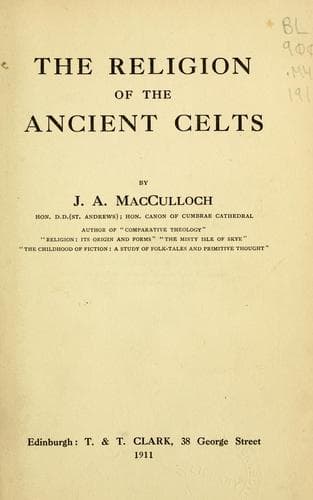
The Religion of the Ancient CeltsMacCulloch, J. A. (John Arnott)
Religion
The Religion of the Ancient Celts
MacCulloch, J. A. (John Arnott)
Celts -- Religion; Mythology, Celtic
Some writers have tried to draw a distinction between the Druids of Gaul
and of Ireland, especially in the matter of their priestly
functions.[1066] But, while a few passages in Irish texts do suggest
that the Irish Druids were priests taking part in sacrifices, etc.,
nearly all passages relating to cult or ritual seem to have been
deliberately suppressed. Hence the Druids appear rather as magicians--a
natural result, since, once the people became Christian, the priestly
character of the Druids would tend to be lost sight of. Like the Druids
of Gaul, they were teachers and took part in political affairs, and this
shows that they were more than mere magicians. In Irish texts the word
"Druid" is somewhat loosely used and is applied to kings and poets,
perhaps because they had been pupils of the Druids. But it is impossible
to doubt that the Druids in Ireland fulfilled functions of a public
priesthood. They appear in connection with all the colonies which came
to Erin, the annalists regarding the priests or medicine-men of
different races as Druids, through lack of historic perspective. But one
fact shows that they were priests of the Celtic religion in Ireland. The
euhemerised Tuatha Dé Danann are masters of Druidic lore. Thus both the
gods and the priests who served them were confused by later writers. The
opposition of Christian missionaries to the Druids shows that they were
priests; if they were not, it remains to be discovered what body of men
did exercise priestly functions in pagan Ireland. In Ireland their
judicial functions may have been less important than in Gaul, and they
may not have been so strictly organised; but here we are in the region
of conjecture. They were exempt from military service in Gaul, and many
joined their ranks on this account, but in Ireland they were "bonny
fechters," just as in Gaul they occasionally fought like mediæval
bishops.[1067] In both countries they were present on the field of
battle to perform the necessary religious or magical rites.
Since the Druids were an organised priesthood, with powers of teaching
and of magic implicitly believed in by the folk, possessing the key of
the other-world, and dominating the whole field of religion, it is easy
to see how much veneration must have been paid them. Connoting this with
the influence of the Roman Church in Celtic regions and the power of the
Protestant minister in the Highlands and in Wales, some have thought
that there is an innate tendency in the Celt to be priest-ridden. If
this be true, we can only say, "the people wish to have it so, and the
priests--pagan, papist, or protestant--bear rule through their means!"
Thus a close examination of the position and functions of the Druids
explains away two popular misconceptions. They were not possessed of any
recondite and esoteric wisdom. And the culling of mistletoe instead of
being the most important, was but a subordinate part of their functions.
Public-domain text, read in full here on John Shaqi.
Reviews
Reviews
No reviews yet
Be the first to share your thoughts on this work.
Elsewhere in the archive
Join the Discussion
Join the discussion
Sign in to leave a comment or review.
Sign InorCreate an account