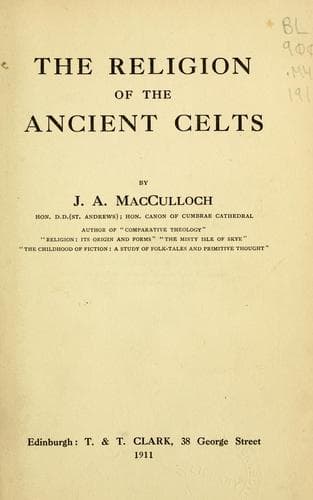
The Religion of the Ancient CeltsMacCulloch, J. A. (John Arnott)
Religion
The Religion of the Ancient Celts
MacCulloch, J. A. (John Arnott)
Celts -- Religion; Mythology, Celtic
In Gaul the Roman power broke the sway of the Druids, aided perhaps by
the spread of Christianity, but it was Christianity alone which routed
them in Ireland and in Britain outside the Roman pale. The Druidic
organisation, their power in politics and in the administration of
justice, their patriotism, and also their use of human sacrifice and
magic, were all obnoxious to the Roman Government, which opposed them
mainly on political grounds. Magic and human sacrifice were suppressed
because they were contrary to Roman manners. The first attack was in the
reign of Augustus, who prohibited Roman citizens from taking part in the
religion of the Druids.[1068] Tiberius next interdicted the Druids, but
this was probably aimed at their human sacrifices, for the Druids were
not suppressed, since they existed still in the reign of Claudius, who
is said to have abolished _Druidarum religionem dirae
immanitatis_.[1069] The earlier legislation was ineffective; that of
Claudius was more thorough, but it, too, was probably aimed mainly at
human sacrifice and magic, since Aurelius Victor limits it to the
"notorious superstitions" of the Druids.[1070] It did not abolish the
native religion, as is proved by the numerous inscriptions to Celtic
gods, and by the fact that, as Mela informs us, human victims were still
offered symbolically,[1071] while the Druids were still active some
years later. A parallel is found in the British abolition of S[=a]ti in
India, while permitting the native religion to flourish.
Probably more effective was the policy begun by Augustus. Magistrates
were inaugurated and acted as judges, thus ousting the Druids, and
native deities and native ritual were assimilated to those of Rome.
Celtic religion was Romanised, and if the Druids retained priestly
functions, it could only be by their becoming Romanised also. Perhaps
the new State religion in Gaul simply ignored them. The annual assembly
of deputies at Lugudunum round the altar of Rome and Augustus had a
religious character, and was intended to rival and to supersede the
annual gathering of the Druids.[1072] The deputies elected a flamen of
the province who had surveillance of the cult, and there were also
flamens for each city. Thus the power of the Druids in politics, law,
and religion was quietly undermined, while Rome also struck a blow at
their position as teachers by establishing schools throughout
Gaul.[1073]
Public-domain text, read in full here on John Shaqi.
Reviews
Reviews
No reviews yet
Be the first to share your thoughts on this work.
Elsewhere in the archive
Join the Discussion
Join the discussion
Sign in to leave a comment or review.
Sign InorCreate an account