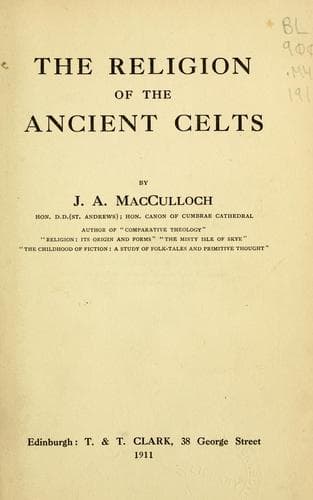
The Religion of the Ancient CeltsMacCulloch, J. A. (John Arnott)
Religion
The Religion of the Ancient Celts
MacCulloch, J. A. (John Arnott)
Celts -- Religion; Mythology, Celtic
The Celts, like all other races, were devoted to magical practices, many
of which could be used by any one, though, on the whole, they were in
the hands of the Druids, who in many aspects were little higher than the
shamans of barbaric tribes. But similar magical rites were also
attributed to the gods, and it is probably for this reason that the
Tuatha Dé Danann and many of the divinities who appear in the
_Mabinogion_ are described as magicians. Kings are also spoken of as
wizards, perhaps a reminiscence of the powers of the priest king. But
since many of the primitive cults had been in the hands of women, and as
these cults implied a large use of magic, they may have been the
earliest wielders of magic, though, with increasing civilisation, men
took their place as magicians. Still side by side with the
magic-wielding Druids, there were classes of women who also dealt in
magic, as we have seen. Their powers were feared, even by S. Patrick,
who classes the "spells of women" along with those of Druids, and, in a
mythic tale, by the father of Connla, who, when the youth was fascinated
by a goddess, feared that he would be taken by the "spells of women"
(_brichta ban_).[1093] In other tales women perform all such magical
actions as are elsewhere ascribed to Druids.[1094] And after the Druids
had passed away precisely similar actions--power over the weather, the
use of incantations and amulets, shape-shifting and invisibility,
etc.--were, and still are in remote Celtic regions, ascribed to witches.
Much of the Druidic art, however, was also supposed to be possessed by
saints and clerics, both in the past and in recent times. But women
remained as magicians when the Druids had disappeared, partly because of
female conservatism, partly because, even in pagan times, they had
worked more or less secretly. At last the Church proscribed them and
persecuted them.
Each clan, tribe, or kingdom had its Druids, who, in time of war,
assisted their hosts by magic art. This is reflected back upon the
groups of the mythological cycle, each of which has its Druids who play
no small part in the battles fought. Though Pliny recognises the
priestly functions of the Druids, he associates them largely with magic,
and applies the name _magus_ to them.[1095] In Irish ecclesiastical
literature, _drui_ is used as the translation of _magus_, e.g. in the
case of the Egyptian magicians, while _magi_ is used in Latin lives of
saints as the equivalent of the vernacular _druides_.[1096] In the sagas
and in popular tales _Druidecht_, "Druidism," stands for "magic," and
_slat an draoichta_, "rod of Druidism," is a magic wand.[1097] The
Tuatha Dé Danann were said to have learned "Druidism" from the four
great master Druids of the region whence they had come to Ireland, and
even now, in popular tales, they are often called "Druids" or "Danann
Druids."[1098] Thus in Ireland at least there is clear evidence of the
great magical power claimed by Druids.
Public-domain text, read in full here on John Shaqi.
Reviews
Reviews
No reviews yet
Be the first to share your thoughts on this work.
Elsewhere in the archive
Join the Discussion
Join the discussion
Sign in to leave a comment or review.
Sign InorCreate an account