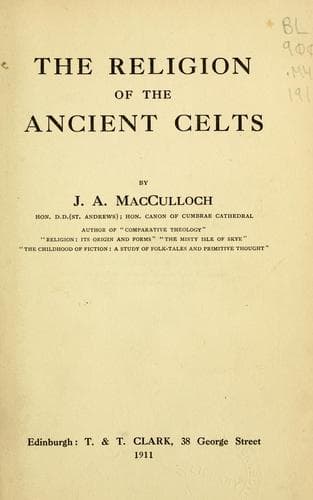
The Religion of the Ancient CeltsMacCulloch, J. A. (John Arnott)
Religion
The Religion of the Ancient Celts
MacCulloch, J. A. (John Arnott)
Celts -- Religion; Mythology, Celtic
That power was exercised to a great extent over the elements, some of
which Druids claimed to have created. Thus the Druid Cathbad covered the
plain over which Deirdre was escaping with "a great-waved sea."[1099]
Druids also produced blinding snow-storms, or changed day into
night--feats ascribed to them even in the Lives of Saints.[1100] Or they
discharge "shower-clouds of fire" on the opposing hosts, as in the case
of the Druid Mag Ruith, who made a magic fire, and flying upwards
towards it, turned it upon the enemy, whose Druid in vain tried to
divert it.[1101] When the Druids of Cormac dried up all the waters in
the land, another Druid shot an arrow, and where it fell there issued a
torrent of water.[1102] The Druid Mathgen boasted of being able to throw
mountains on the enemy, and frequently Druids made trees or stones
appear as armed men, dismaying the opposing host in this way. They could
also fill the air with the clash of battle, or with the dread cries of
eldritch things.[1103] Similar powers are ascribed to other persons. The
daughters of Calatin raised themselves aloft on an enchanted wind, and
discovered Cúchulainn when he was hidden away by Cathbad. Later they
produced a magic mist to discomfit the hero.[1104] Such mists occur
frequently in the sagas, and in one of them the Tuatha Dé Danann arrived
in Ireland. The priestesses of Sena could rouse sea and wind by their
enchantments, and, later, Celtic witches have claimed the same power.
In folk-survivals the practice of rain-making is connected with sacred
springs, and even now in rural France processions to shrines, usually
connected with a holy well, are common in time of drought. Thus people
and priest go to the fountain of Baranton in procession, singing hymns,
and there pray for rain. The priest then dips his foot in the water, or
throws some of it on the rocks.[1105] In other cases the image of a
saint is carried to a well and asperged, as divine images formerly were,
or the waters are beaten or thrown into the air.[1106] Another custom
was that a virgin should clean out a sacred well, and formerly she had
to be nude.[1107] Nudity also forms part of an old ritual used in Gaul.
In time of drought the girls of the village followed the youngest virgin
in a state of nudity to seek the herb _belinuntia_. This she uprooted,
and was then led to a river and there asperged by the others. In this
case the asperging imitated the falling rain, and was meant to produce
it automatically. While some of these rites suggest the use of magic by
the folk themselves, in others the presence of the Christian priest
points to the fact that, formerly, a Druid was necessary as the rain
producer. In some cases the priest has inherited through long ages the
rain-making or tempest-quelling powers of the pagan priesthood, and is
often besought to exercise them.[1108]
Public-domain text, read in full here on John Shaqi.
Reviews
Reviews
No reviews yet
Be the first to share your thoughts on this work.
Elsewhere in the archive
Join the Discussion
Join the discussion
Sign in to leave a comment or review.
Sign InorCreate an account