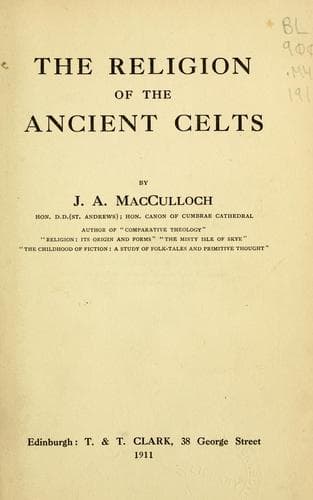
The Religion of the Ancient CeltsMacCulloch, J. A. (John Arnott)
Religion
The Religion of the Ancient Celts
MacCulloch, J. A. (John Arnott)
Celts -- Religion; Mythology, Celtic
By a "drink of oblivion" Druids and other persons could make one forget
even the most dearly beloved. Thus Cúchulainn was made to forget Fand,
and his wife Emer to forget her jealousy.[1115] This is a reminiscence
of potent drinks brewed from herbs which caused hallucinations, e.g.
that of the change of shape. In other cases they were of a narcotic
nature and caused a deep sleep, an instance being the draught given by
Grainne to Fionn and his men.[1116] Again, the "Druidic sleep" is
suggestive of hypnotism, practised in distant ages and also by
present-day savages. When Bodb suspected his daughter of lying he cast
her into a "Druidic sleep," in which she revealed her wickedness.[1117]
In other cases spells are cast upon persons so that they are
hallucinated, or are rendered motionless, or, "by the sleight of hand of
soothsayers," maidens lose their chastity without knowing it.[1118]
These point to knowledge of hypnotic methods of suggestion. Or, again, a
spectral army is opposed to an enemy's force to whom it is an
hallucinatory appearance--perhaps an exaggeration of natural hypnotic
powers.[1119]
Druids also made a "hedge," the _airbe druad_, round an army, perhaps
circumambulating it and saying spells so that the attacking force might
not break through. If any one could leap this "hedge," the spell was
broken, but he lost his life. This was done at the battle of Cul Dremne,
at which S. Columba was present and aided the heroic leaper with his
prayers.[1120]
A primitive piece of sympathetic magic used still by savages is recorded
in the _Rennes Dindsenchas_. In this story one man says spells over his
spear and hurls it into his opponent's shadow, so that he falls
dead.[1121] Equally primitive is the Druidic "sending" a wisp of straw
over which the Druid sang spells and flung it into his victim's face, so
that he became mad. A similar method is used by the Eskimo _angekok_.
All madness was generally ascribed to such a "sending."
Public-domain text, read in full here on John Shaqi.
Reviews
Reviews
No reviews yet
Be the first to share your thoughts on this work.
Elsewhere in the archive
Join the Discussion
Join the discussion
Sign in to leave a comment or review.
Sign InorCreate an account