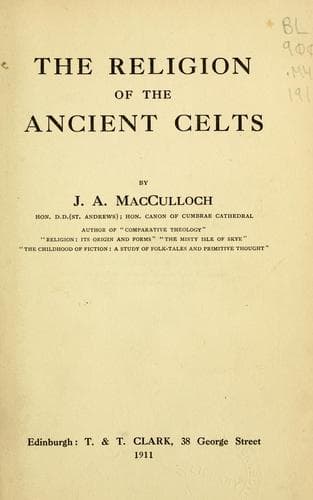
The Religion of the Ancient CeltsMacCulloch, J. A. (John Arnott)
Religion
The Religion of the Ancient Celts
MacCulloch, J. A. (John Arnott)
Celts -- Religion; Mythology, Celtic
Several of these instances have shown the use of spells, and the Druid
was believed to possess powerful incantations to discomfit an enemy or
to produce other magical results. A special posture was
adopted--standing on one leg, with one arm outstretched and one eye
closed, perhaps to concentrate the force of the spell,[1122] but the
power lay mainly in the spoken words, as we have seen in discussing
Celtic formulæ of prayer. Such spells were also used by the _Filid_, or
poets, since most primitive poetry has a magical aspect. Part of the
training of the bard consisted in learning traditional incantations,
which, used with due ritual, produced the magic result.[1123] Some of
these incantations have already come before our notice, and probably
some of the verses which Cæsar says the Druids would not commit to
writing were of the nature of spells.[1124] The virtue of the spell lay
in the spoken formula, usually introducing the name of a god or spirit,
later a saint, in order to procure his intervention, through the power
inherent in the name. Other charms recount an effect already produced,
and this, through mimetic magic, is supposed to cause its repetition.
The earliest written documents bearing upon the paganism of the insular
Celts contain an appeal to "the science of Goibniu" to preserve butter,
and another, for magical healing, runs, "I admire the healing which
Diancecht left in his family, in order to bring health to those he
succoured." These are found in an eighth or ninth century MS., and, with
their appeal to pagan gods, were evidently used in Christian
times.[1125] Most Druidic magic was accompanied by a spell--
transformation, invisibility, power over the elements, and the discovery
of hidden persons or things. In other cases spells were used in medicine
or for healing wounds. Thus the Tuatha Dé Danann told the Fomorians that
they need not oppose them, because their Druids would restore the slain
to life, and when Cúchulainn was wounded we hear less of medicines than
of incantations used to stanch his blood.[1126] In other cases the Druid
could remove barrenness by spells.
Public-domain text, read in full here on John Shaqi.
Reviews
Reviews
No reviews yet
Be the first to share your thoughts on this work.
Elsewhere in the archive
Join the Discussion
Join the discussion
Sign in to leave a comment or review.
Sign InorCreate an account