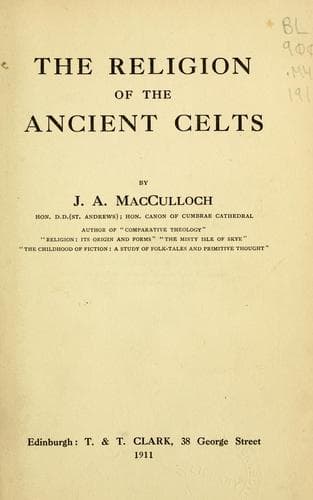
The Religion of the Ancient CeltsMacCulloch, J. A. (John Arnott)
Religion
The Religion of the Ancient Celts
MacCulloch, J. A. (John Arnott)
Celts -- Religion; Mythology, Celtic
The survival of the belief in spells among modern Celtic peoples is a
convincing proof of their use in pagan times, and throws light upon
their nature. In Brittany they are handed down in certain families, and
are carefully guarded from the knowledge of others. The names of saints
instead of the old gods are found in them, but in some cases diseases
are addressed as personal beings. In the Highlands similar charms are
found, and are often handed down from male to female, and from female to
male. They are also in common use in Ireland. Besides healing diseases,
such charms are supposed to cause fertility or bring good luck, or even
to transfer the property of others to the reciter, or, in the case of
darker magic, to cause death or disease.[1127] In Ireland, sorcerers
could "rime either a man or beast to death," and this recalls the power
of satire in the mouth of _File_ or Druid. It raised blotches on the
face of the victim, or even caused his death.[1128] Among primitive
races powerful internal emotion affects the body in curious ways, and in
this traditional power of the satire or "rime" we have probably an
exaggerated reference to actual fact. In other cases the "curse of
satire" affected nature, causing seas and rivers to sink back.[1129] The
satires made by the bards of Gaul, referred to by Diodorus, may have
been believed to possess similar powers.[1130] Contrariwise, the
_Filid_, on uttering an unjust judgment, found their faces covered with
blotches.[1131]
A magical sleep is often caused by music in the sagas, e.g. by the harp
of Dagda, or by the branch carried by visitants from Elysium.[1132] Many
"fairy" lullabies for producing sleep are even now extant in Ireland and
the Highlands.[1133] As music forms a part of all primitive religion,
its soothing powers would easily be magnified. In orgiastic rites it
caused varying emotions until the singer and dancer fell into a deep
slumber, and the tales of those who joined in a fairy dance and fell
asleep, awaking to find that many years had passed, are mythic
extensions of the power of music in such orgiastic cults. The music of
the _Filid_ had similar powers to that of Dagda's harp, producing
laughter, tears, and a delicious slumber,[1134] and Celtic folk-tales
abound in similar instances of the magic charm of music.
Public-domain text, read in full here on John Shaqi.
Reviews
Reviews
No reviews yet
Be the first to share your thoughts on this work.
Elsewhere in the archive
Join the Discussion
Join the discussion
Sign in to leave a comment or review.
Sign InorCreate an account