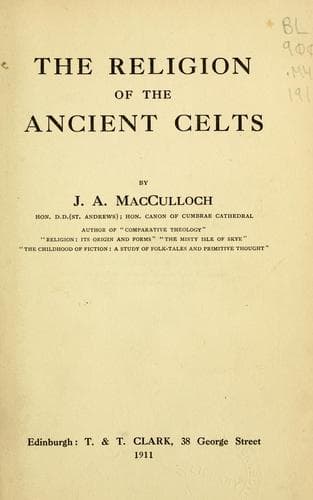
The Religion of the Ancient CeltsMacCulloch, J. A. (John Arnott)
Religion
The Religion of the Ancient Celts
MacCulloch, J. A. (John Arnott)
Celts -- Religion; Mythology, Celtic
A cult of stones was probably connected with the belief in the magical
power of certain stones, like the _Lia Fail_, which shrieked aloud when
Conn knocked against it. His Druids explained that the number of the
shrieks equalled the number of his descendants who should be kings of
Erin.[1143] This is an ætiological myth accounting for the use of this
fetich-stone at coronations. Other stones, probably the object of a cult
or possessing magical virtues, were used at the installation of chiefs,
who stood on them and vowed to follow in the steps of their
predecessors, a pair of feet being carved on the stone to represent
those of the first chief.[1144] Other stones had more musical
virtues--the "conspicuous stone" of Elysium from which arose a hundred
strains, and the melodious stone of Loch Láig. Such beliefs existed into
Christian times. S. Columba's stone altar floated on the waves, and on
it a leper had crossed in the wake of the saint's coracle to Erin. But
the same stone was that on which, long before, the hero Fionn had
slipped.[1145]
Connected with the cult of stones are magical observances at fixed rocks
or boulders, regarded probably as the abode of a spirit. These
observances are in origin pre-Celtic, but were practised by the Celts.
Girls slide down a stone to obtain a lover, pregnant women to obtain an
easy delivery, or contact with such stones causes barren women to have
children or gives vitality to the feeble. A small offering is usually
left on the stone.[1146] Similar rites are practised at megalithic
monuments, and here again the custom is obviously pre-Celtic in origin.
In this case the spirits of the dead must have been expected to assist
the purposes of the rites, or even to incarnate themselves in the
children born as a result of barren women resorting to these
stones.[1147] Sometimes when the purpose of the stones has been
forgotten and some other legendary origin attributed to them, the custom
adapts itself to the legend. In Ireland many dolmens are known, not as
places of sepulture, but as "Diarmaid and Grainne's beds"--the places
where these eloping lovers slept. Hence they have powers of fruitfulness
and are visited by women who desire children. The rite is thus one of
sympathetic magic.
Public-domain text, read in full here on John Shaqi.
Reviews
Reviews
No reviews yet
Be the first to share your thoughts on this work.
Elsewhere in the archive
Join the Discussion
Join the discussion
Sign in to leave a comment or review.
Sign InorCreate an account