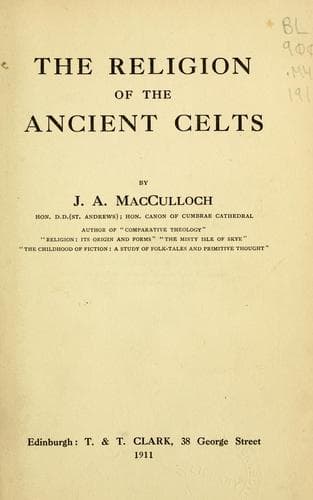
The Religion of the Ancient CeltsMacCulloch, J. A. (John Arnott)
Religion
The Religion of the Ancient Celts
MacCulloch, J. A. (John Arnott)
Celts -- Religion; Mythology, Celtic
Holed dolmens or naturally pierced blocks are used for the magical cure
of sickness both in Brittany and Cornwall, the patient being passed
through the hole.[1148] Similar rites are used with trees, a slit being
often made in the trunk of a sapling, and a sickly child passed through
it. The slit is then closed and bound, and if it joins together at the
end of a certain time, this is a proof that the child will
recover.[1149] In these rites the spirit in stone or tree was supposed
to assist the process of healing, or the disease was transferred to
them, or, again, there was the idea of a new birth with consequent
renewed life, the act imitating the process of birth. These rites are
not confined to Celtic regions, but belong to that universal use of
magic in which the Celts freely participated.
Since Christian writers firmly believed in the magical powers of the
Druids, aided however by the devil, they taught that Christian saints
had miraculously overcome them with their own weapons. S. Patrick
dispelled snow-storms and darkness raised by Druids, or destroyed Druids
who had brought down fire from heaven. Similar deeds are attributed to
S. Columba and others.[1150] The moral victory of the Cross was later
regarded also as a magical victory. Hence also lives of Celtic saints
are full of miracles which are simply a reproduction of Druidic
magic--controlling the elements, healing, carrying live coals without
hurt, causing confusion by their curses, producing invisibility or
shape-shifting, making the ice-cold waters of a river hot by standing in
them at their devotions, or walking unscathed through the fiercest
storms.[1151] They were soon regarded as more expert magicians than the
Druids themselves. They may have laid claim to magical powers, or
perhaps they used a natural shrewdness in such a way as to suggest
magic. But all their power they ascribed to Christ. "Christ is my
Druid"--the true miracle-worker, said S. Columba. Yet they were imbued
with the superstitions of their own age. Thus S. Columba sent a white
stone to King Brude at Inverness for the cure of his Druid Broichan, who
drank the water poured over it, and was healed.[1152] Soon similar
virtues were ascribed to the relics of the saints themselves, and at a
later time, when most Scotsmen ceased to believe in the saints, they
thought that the ministers of the kirk had powers like those of pagan
Druid and Catholic saint. Ministers were levitated, or shone with a
celestial light, or had clairvoyant gifts, or, with dire results, cursed
the ungodly or the benighted prelatist. They prophesied, used
trance-utterance, and exercised gifts of healing. Angels ministered to
them, as when Samuel Rutherford, having fallen into a well when a child,
was pulled out by an angel.[1153] The substratum of primitive belief
survives all changes of creed, and the folk impartially attributed
magical powers to pagan Druid, Celtic saints, old crones and witches,
and Presbyterian ministers.
FOOTNOTES:
Public-domain text, read in full here on John Shaqi.
Reviews
Reviews
No reviews yet
Be the first to share your thoughts on this work.
Elsewhere in the archive
Join the Discussion
Join the discussion
Sign in to leave a comment or review.
Sign InorCreate an account