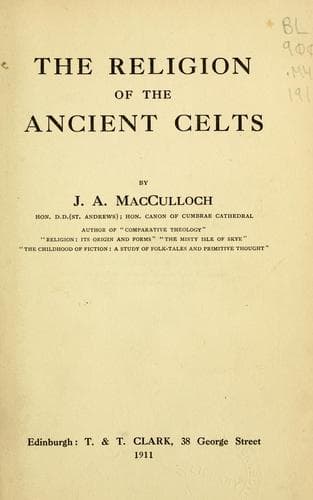
The Religion of the Ancient CeltsMacCulloch, J. A. (John Arnott)
Religion
The Religion of the Ancient Celts
MacCulloch, J. A. (John Arnott)
Celts -- Religion; Mythology, Celtic
If there was a genuine Celtic belief in an island of the dead, it could
have been no more than a local one, else Cæsar would not have spoken as
he does of the Celtic Dispater. Such a local belief now exists on the
Breton coast, but it is mainly concerned with the souls of the
drowned.[1178] A similar local belief may explain the story told by
Procopius, who says that Brittia (Britain), an island lying off the
mouth of the Rhine, is divided from north to south by a wall beyond
which is a noxious region. This is a distorted reminiscence of the Roman
wall, which would appear to run in this direction if Ptolemy's map, in
which Scotland lies at right angles to England, had been consulted.
Thither fishermen from the opposite coast are compelled to ferry over at
dead of night the shades of the dead, unseen to them, but marshalled by
a mysterious leader.[1179] Procopius may have mingled some local belief
with the current tradition that Ulysses' island of the shades lay in the
north, or in the west.[1180] In any case his story makes of the gloomy
land of the shades a very different region from the blissful Elysium of
the Celts and from their joyous _orbis alius_, nor is it certain that he
is referring to a Celtic people.
Traces of the idea of an underworld of the dead exist in Breton
folk-belief. The dead must travel across a subterranean ocean, and
though there is scarcely any tradition regarding what happens on
landing, M. Sébillot thinks that formerly "there existed in the
subterranean world a sort of centralisation of the different states of
the dead." If so, this must have been founded on pagan belief. The
interior of the earth is also believed to be the abode of fabulous
beings, of giants, and of fantastic animals, and there is also a
subterranean fairy world. In all this we may see a survival of the older
belief, modified by Christian teaching, since the Bretons suppose that
purgatory and hell are beneath the earth and accessible from its
surface.[1181]
Public-domain text, read in full here on John Shaqi.
Reviews
Reviews
No reviews yet
Be the first to share your thoughts on this work.
Elsewhere in the archive
Join the Discussion
Join the discussion
Sign in to leave a comment or review.
Sign InorCreate an account