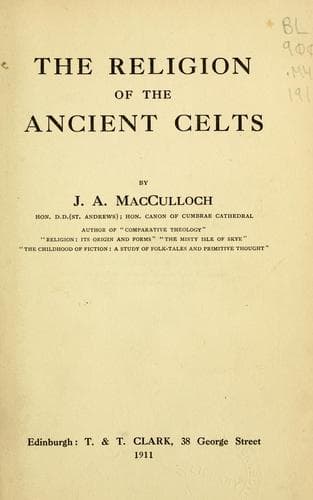
The Religion of the Ancient CeltsMacCulloch, J. A. (John Arnott)
Religion
The Religion of the Ancient Celts
MacCulloch, J. A. (John Arnott)
Celts -- Religion; Mythology, Celtic
Some British folk-lore brought to Greece by Demetrius and reported by
Plutarch might seem to suggest that certain persons--the mighty
dead--were privileged to pass to the island Elysium. Some islands near
Britain were called after gods and heroes, and the inhabitants of one of
these were regarded as sacrosanct by the Britons, like the priestesses
of Sena. They were visited by Demetrius, who was told that the storms
which arose during his visit were caused by the passing away of some of
the "mighty" or of the "great souls." It may have been meant that such
mighty ones passed to the more distant islands, but this is certainly
not stated. In another island, Kronos was imprisoned, watched over by
Briareus, and guarded by demons.[1182] Plutarch refers to these islands
in another work, repeating the story of Kronos, and saying that his
island is mild and fragrant, that people live there waiting on the god
who sometimes appears to them and prevents their departing. Meanwhile
they are happy and know no care, spending their time in sacrificing and
hymn-singing or in studying legends and philosophy.
Plutarch has obviously mingled Celtic Elysium beliefs with the classical
conception of the Druids.[1183] In Elysium there is no care, and
favoured mortals who pass there are generally prevented from returning
to earth. The reference to Kronos may also be based partly on myths of
Celtic gods of Elysium, partly on tales of heroes who departed to
mysterious islands or to the hollow hills where they lie asleep, but
whence they will one day return to benefit their people. So Arthur
passed to Avalon, but in other tales he and his warriors are asleep
beneath Craig-y-Ddinas, just as Fionn and his men rest within this or
that hill in the Highlands. Similar legends are told of other Celtic
heroes, and they witness to the belief that great men who had died would
return in the hour of their people's need. In time they were thought not
to have died at all, but to be merely sleeping and waiting for their
hour.[1184] The belief is based on the idea that the dead are alive in
grave or barrow, or in a spacious land below the earth, or that dead
warriors can menace their foes from the tomb.
Thus neither in old sagas, nor in _Märchen_, nor in popular tradition,
is the island Elysium a world of the dead. For the most part the pagan
eschatology has been merged in that of Christianity, while the Elysium
belief has remained intact and still survives in a whole series of
beautiful tales.
Public-domain text, read in full here on John Shaqi.
Reviews
Reviews
No reviews yet
Be the first to share your thoughts on this work.
Elsewhere in the archive
Join the Discussion
Join the discussion
Sign in to leave a comment or review.
Sign InorCreate an account