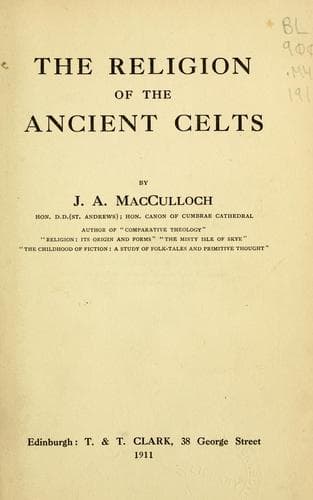
The Religion of the Ancient CeltsMacCulloch, J. A. (John Arnott)
Religion
The Religion of the Ancient Celts
MacCulloch, J. A. (John Arnott)
Celts -- Religion; Mythology, Celtic
The god with the hammer is a gracious bearded figure, clad in Gaulish
dress, and he carries also a cup. His plastic type is derived from that
of the Alexandrian Serapis, ruler of the underworld, and that of
Hades-Pluto.[82] His emblems, especially that of the hammer, are also
those of the Pluto of the Etruscans, with whom the Celts had been in
contact.[83] He is thus a Celtic Dispater, an underworld god, possibly
at one time an Earth-god and certainly a god of fertility, and ancestor
of the Celtic folk. In some cases, like Serapis, he carries a _modius_
on his head, and this, like the cup, is an emblem of chthonian gods, and
a symbol of the fertility of the soil. The god being benevolent, his
hammer, like the tool with which man forms so many things, could only be
a symbol of creative force.[84] As an ancestor of the Celts, the god is
naturally represented in Celtic dress. In one bas-relief he is called
Sucellos, and has a consort, Nantosvelta.[85] Various meanings have been
assigned to "Sucellos," but it probably denotes the god's power of
striking with the hammer. M. D'Arbois hence regards him as a god of
blight and death, like Balor.[86] But though this Celtic Dispater was a
god of the dead who lived on in the underworld, he was not necessarily a
destructive god. The underworld god was the god from whom or from whose
kingdom men came forth, and he was also a god of fertility. To this we
shall return.
2. A bearded god, probably squatting, with horns from each of which
hangs a torque, is represented on an altar found at Paris.[87] He is
called Cernunnos, perhaps "the horned," from _cerna_, "horn," and a
whole group of nameless gods, with similar or additional attributes,
have affinities with him.
(a) A bronze statuette from Autun represents a similar figure, probably
horned, who presents a torque to two ram's-headed serpents. Fixed above
his ears are two small heads.[88] On a monument from Vandoeuvres is a
squatting horned god, pressing a sack. Two genii stand beside him on a
serpent, while one of them holds a torque.[89]
(b) Another squatting horned figure with a torque occurs on an altar
from Reims. He presses a bag, from which grain escapes, and on it an ox
and stag are feeding. A rat is represented on the pediment above, and on
either side stand Apollo and Mercury.[90] On the altar of Saintes is a
squatting but headless god with torque and purse. Beside him is a
goddess with a cornucopia, and a smaller divinity with a cornucopia and
an apple. A similar squatting figure, supported by male and female
deities, is represented on the other side of the altar.[91] On the altar
of Beaune are three figures, one horned with a cornucopia, another
three-headed, holding a basket.[92] Three figures, one female and two
male, are found on the Dennevy altar. One god is three-faced, the other
has a cornucopia, which he offers to a serpent.[93]
(c) Another image represents a three-faced god, holding a serpent with a
ram's head.[94]
Public-domain text, read in full here on John Shaqi.
Reviews
Reviews
No reviews yet
Be the first to share your thoughts on this work.
Join the Discussion
Join the discussion
Sign in to leave a comment or review.
Sign InorCreate an account