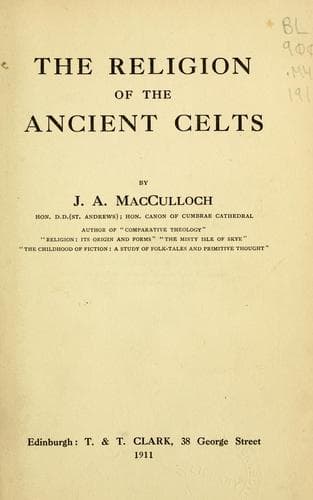
The Religion of the Ancient CeltsMacCulloch, J. A. (John Arnott)
Religion
The Religion of the Ancient Celts
MacCulloch, J. A. (John Arnott)
Celts -- Religion; Mythology, Celtic
[1167] Vigfusson-Powell, _Corpus Poet. Boreale_, i. 167, 417-418, 420;
and see my _Childhood of Fiction_, 103 f.
[1168] Larminie, 31; Le Braz{2}, ii. 146, 159, 161, 184, 257 (the _rôle_
of the dead husband is usually taken by a _lutin_ or _follet_, Luzel,
_Veillées Bretons_, 79); _Rev. des Trad. Pop._ ii. 267; _Ann. de
Bretagne_, viii. 514.
[1169] Le Braz{2}, i. 313. Cf. also an incident in the _Voyage of
Maelduin_.
[1170] _RC_ x. 214f. Cf. Kennedy, 162; Le Braz{2}, i. 217, for variants.
[1171] Curtin, _Tales_, 156; see p. 170, _supra_.
[1172] Curtin, _Tales_, 156; Campbell, _Superstitions_, 241;
_Folk-Lore_, xiii. 60; Le Braz{2}, i. 213.
[1173] _Folk-Lore_, ii. 26; Yeats, _Celtic Twilight_, 166.
[1174] Tertullian, _de Anima_, 21.
[1175] Reinach, _RC_ xxii. 447.
[1176] Val. Max. vi. 6; Mela, iii. 2. 19; Plut. _Virt. mul_ 20.
[1177] See p. 229, _supra_.
[1178] Le Braz{2}, i. p. xxxix. This is only one out of many local
beliefs (cf. Sébillot, ii. 149).
[1179] Procop. _De Bello Goth._ vi. 20.
[1180] Claudian, _In Rufin._ i. 123.
[1181] Sébillot, i. 418 f.
[1182] _de Defectu Orac._ 18. An occasional name for Britain in the
_Mabinogion_ is "the island of the Mighty" (Loth, i. 69, _et passim_).
To the storm incident and the passing of the mighty, there is a curious
parallel in Fijian belief. A clap of thunder was explained as "the noise
of a spirit, we being near the place in which spirits plunge to enter
the other world, and a chief in the neighbourhood having just died"
(Williams, _Fiji_, i. 204).
[1183] _de Facie Lun[oe]_, 26.
[1184] See Hartland, _Science of Fairy Tales_, 209; Macdougall, _Folk
and Hero Tales_, 73, 263; Le Braz{2}, i. p. xxx. Mortals sometimes
penetrated to the presence of these heroes, who awoke. If the visitor
had the courage to tell them that the hour had not yet come, they fell
asleep again, and he escaped. In Brittany, rocky clefts are believed to
be the entrance to the world of the dead, like the cave of Lough Dearg.
Similar stories were probably told of these in pagan times, though they
are now adapted to Christian beliefs in purgatory or hell.
[1185] Le Braz{2}, i. p. xl, ii. 4; Curtin, 10; MacPhail, _Folk-Lore_,
vi. 170.
[1186] See p. 338, _supra_, and Logan, _Scottish Gael_, ii. 374;
_Folk-Lore,_ viii. 208, 253.
[1187] Le Braz{2}, i. 96, 127, 136f., and Intro, xlv.
[1188] Philostratus, _Apoll. of Tyana_, v. 4; Val. Max. ii. 6. 12.
[1189] Le Braz{1}, ii. 91; Curtin, _Tales_, 146. The punishment of
suffering from ice and snow appears in the _Apocalypse of Paul_ and in
later Christian accounts of hell.
[1190] _RC_ xxvi. 153.
[1191] Bk. iv. ch. 36.
[1192] _Erdathe_, according to D'Arbois, means (1) "the day in which the
dead will resume his colour," from _dath_, "colour"; (2) "the agreeable
day," from _data_, "agreeable" (D'Arbois, i. 185; cf. _Les Druides_,
135).
CHAPTER XXIII.
REBIRTH AND TRANSMIGRATION.
Public-domain text, read in full here on John Shaqi.
Reviews
Reviews
No reviews yet
Be the first to share your thoughts on this work.
Elsewhere in the archive
Join the Discussion
Join the discussion
Sign in to leave a comment or review.
Sign InorCreate an account