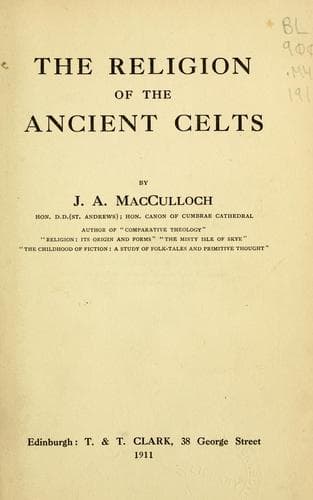
The Religion of the Ancient CeltsMacCulloch, J. A. (John Arnott)
Religion
The Religion of the Ancient Celts
MacCulloch, J. A. (John Arnott)
Celts -- Religion; Mythology, Celtic
There is no decisive evidence pointing to any theory of moral
retribution beyond the grave among the pagan Celts. Perhaps, since the
hope of immortality made warriors face death without a tremor, it may
have been held, as many other races have believed, that cowards would
miss the bliss of the future state. Again, in some of the Irish
Christian visions of the other-world and in existing folk-belief,
certain characteristics of hell may not be derived from Christian
eschatology, e.g. the sufferings of the dead from cold.[1189] This might
point to an old belief in a cold region whither some of the dead were
banished. In the _Adventures of S. Columba's Clerics_, hell is reached
by a bridge over a glen of fire,[1190] and a narrow bridge leading to
the other world is a common feature in most mythologies. But here it may
be borrowed from Scandinavian sources, or from such Christian writings
as the _Dialogues_ of S. Gregory the Great.[1191] It might be contended
that the Christian doctrine of hell has absorbed an earlier pagan theory
of retribution, but of this there is now no trace in the sagas or in
classical references to the Celtic belief in the future life. Nor is
there any reference to a day of judgment, for the passage in which
Loegaire speaks of the dead buried with their weapons till "the day of
Erdathe," though glossed "the day of judgment of the Lord," does not
refer to such a judgment.[1192] If an ethical blindness be attributed to
the Celts for their apparent lack of any theory of retribution, it
should be remembered that we must not judge a people's ethics wholly by
their views of future punishment. Scandinavians, Greeks, and Semites up
to a certain stage were as unethical as the Celts in this respect, and
the Christian hell, as conceived by many theologians, is far from
suggesting an ethical Deity.
FOOTNOTES:
[1154] Skene, i. 370.
[1155] Cæsar, vi. 14, 19.
[1156] Diod. Sic. v, 28.
[1157] Val. Max. vi. 6. 10.
[1158] _Phars._ i. 455 f.
[1159] Amm. Marc. xv. 9; Strabo, iv. 4; Mela, iii. 2.
[1160] Miss Hull, 275.
[1161] Nutt-Meyer, i. 49; Miss Hull, 293.
[1162] Larminie, 155; Hyde, _Beside the Fire_, 21, 153; _CM_ xiii. 21;
Campbell, _WHT_, ii. 21; Le Braz{2}, i. p. xii.
[1163] Von Sacken, _Das Grabfeld von Hallstatt_; Greenwell, _British
Barrows_; _RC_ x. 234; _Antiquary_, xxxvii. 125; Blanchet, ii. 528 f.;
Anderson, _Scotland in Pagan Times_.
[1164] _L'Anthropologie_, vi. 586; Greenwell, _op. cit._ 119.
[1165] Nutt-Meyer, i. 52; O'Donovan, _Annals_, i. 145, 180; _RC_ xv. 28.
In one case the enemy disinter the body of the king of Connaught, and
rebury it face downwards, and then obtain a victory. This nearly
coincides with the dire results following the disinterment of Bran's
head (O'Donovan, i. 145; cf. p. 242, _supra_).
[1166] _LU_ 130_a_; _RC_ xxiv. 185; O'Curry, _MC_ i. p. cccxxx;
Campbell, _WHT_ iii. 62; Leahy, i. 105.
Public-domain text, read in full here on John Shaqi.
Reviews
Reviews
No reviews yet
Be the first to share your thoughts on this work.
Elsewhere in the archive
Join the Discussion
Join the discussion
Sign in to leave a comment or review.
Sign InorCreate an account